Israir to Launch Tel Aviv-New York JFK Flights from 16 September
The Israeli carrier will link Ben Gurion with JFK three times weekly on an Airbus A330-200 from 16 September 2026, rising to six weekly by December as the third Israeli airline on the New York market.
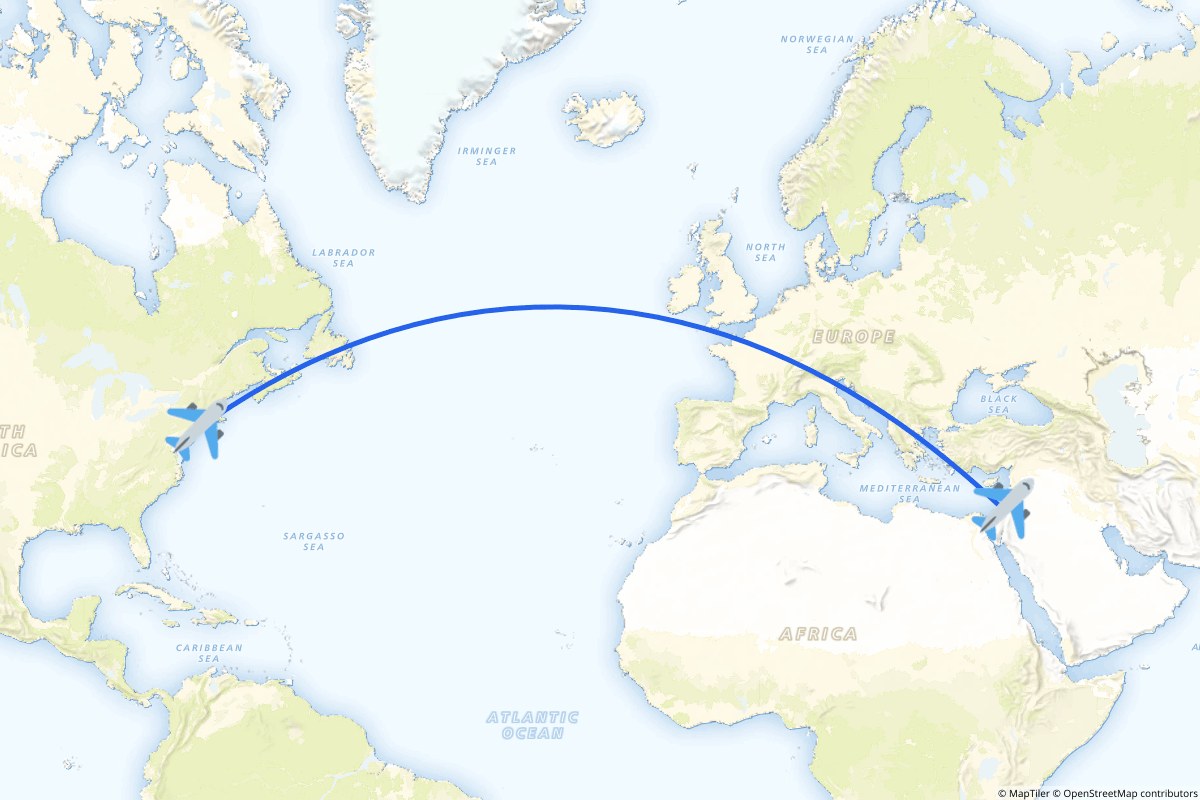
Israir will begin scheduled flights between Tel Aviv and New York on 16 September 2026, linking Ben Gurion International Airport with John F Kennedy International Airport three times weekly using an Airbus A330-200. The launch returns the carrier to transatlantic operations after an absence of more than a decade and a half, and makes it the third Israeli airline competing on the Tel Aviv to New York market.
- Airline
- Israir (6H)
- Route
- Tel Aviv (TLV) to New York (JFK)
- Aircraft
- Airbus A330-200
- Frequency
- 3x weekly, rising to 6x weekly by 1 Dec 2026
- First flight
- 16 Sep 2026
Route overview
Israir will operate the sector three times weekly at launch, adding a fourth weekly rotation from 19 October 2026 and stepping up to six weekly frequencies from 1 December 2026, according to schedule data published by AeroRoutes. The ramp doubles the carrier’s presence on the route inside eleven weeks of the first departure.
At roughly 9,100 kilometres, or about 5,670 miles, Tel Aviv to New York is by some distance the longest sector in Israir’s network and its only scheduled long-haul route. Westbound services will block at around twelve hours against prevailing winds, with eastbound rotations closer to ten and a half. Operating the sector requires a dedicated widebody rotation, a significant commitment for a carrier whose scheduled flying is otherwise measured in sectors of two to five hours.
The launch follows completion of the US regulatory approvals required for the operation. Israir confirmed earlier this month that the clearances needed for its return to the United States were in place, including the Federal Aviation Administration sign-off that stood as the final hurdle before flights could begin.
Israir’s network context
Israir, based at Ben Gurion, operates an Airbus narrowbody fleet on scheduled and charter services to leisure destinations across Europe, the Mediterranean and the Gulf, alongside domestic flights to Eilat. Its network has been built almost entirely on short- and medium-haul sectors, with Athens, Larnaca, Batumi and Dubai among the markets it contests against a crowded field of Israeli and foreign operators.
New York is a return to long-haul flying rather than a first attempt. Israir served the market in the 2000s with Boeing 767 equipment before withdrawing to concentrate on its short-haul core. The JFK launch re-establishes a network position the airline gave up more than fifteen years ago, and it does so with a larger aircraft and a materially deeper schedule than its earlier operation reached.
About the aircraft
The Airbus A330-200 is the longer-range, shorter-fuselage member of the original A330 family. In typical two-class layouts the type seats between 250 and 290 passengers, and its range of roughly 13,400 kilometres covers the Tel Aviv to New York sector with comfortable margin in both directions throughout the year.
First delivered in 1998, the variant has long been a standard entry point into widebody flying for carriers without an existing long-haul operation. It is readily available on the leasing market, its twin-engine economics suit long, thin routes, and it can be deployed at the modest frequencies with which new long-haul services typically start. For Israir, whose scheduled fleet is otherwise composed of A320-family narrowbodies, the A330-200 is the airline’s first widebody programme since the Boeing 767 era.
Ben Gurion and JFK
Network data from bigairports.com shows Ben Gurion connected to 127 destinations on current schedules. The airport’s densest links are medium-haul: Dubai leads with 974 flights, ahead of Madrid on 745 and Amsterdam on 439. Larnaca is the most contested market, with 18 carriers competing on the short Cyprus sector, while Athens draws 13 operators across 334 flights. As Israel’s principal international gateway, Ben Gurion handles nearly all of the country’s scheduled passenger traffic, which concentrates every Israeli carrier’s growth plans on a single field.
John F Kennedy International operates at a different scale, serving 241 destinations, close to double Ben Gurion’s route count. Long-haul trunk routes dominate its schedule: Madrid is the heaviest with 1,941 flights across six carriers, followed by Amsterdam on 1,543 and Barcelona on 930. JFK is New York’s primary long-haul gateway and the established home of Israeli flying to the United States, making it the natural terminus for a full-service transatlantic entrant. For the New York airport, a three-times-weekly widebody service is a marginal addition in capacity terms; for Ben Gurion, it deepens links on the single most important long-haul market in its network.
Market context and competition
Israir arrives on the densest long-haul market out of Israel, and one that has become markedly more crowded through 2026. El Al operates multiple daily rotations between Tel Aviv and JFK and holds the dominant share of nonstop capacity. Arkia became the second Israeli carrier on the New York market earlier in the cycle, leaving Israir to complete the set: for the first time, all three Israeli scheduled airlines will compete on the same long-haul trunk route.
The timing also places the launch directly against the return of the US majors. American carriers have been restoring Tel Aviv services suspended during the security disruptions of recent years, rebuilding nonstop capacity between New York and Israel from both ends of the route. The result is a market with more operators than at any point in the modern era, competing for a traffic base built on strong origin-and-destination demand, family and community ties, and business traffic between Israel and the north-eastern United States.
Israir has not published load or booking targets for the route. What is on the record is the schedule itself: three weekly flights from 16 September, four from 19 October and six from 1 December, operated by a widebody committed to a single long-haul market. The first service departs Tel Aviv on 16 September.
Sources & references (4)
Generated with editorial oversight from AI research.