TransNusa Launches Bali–Phuket A320 Service, Daily From October
TransNusa began four-weekly Airbus A320 flights between Denpasar and Phuket on 9 September 2026, giving the two resort islands their only nonstop link, with frequency rising to daily from 3 October.
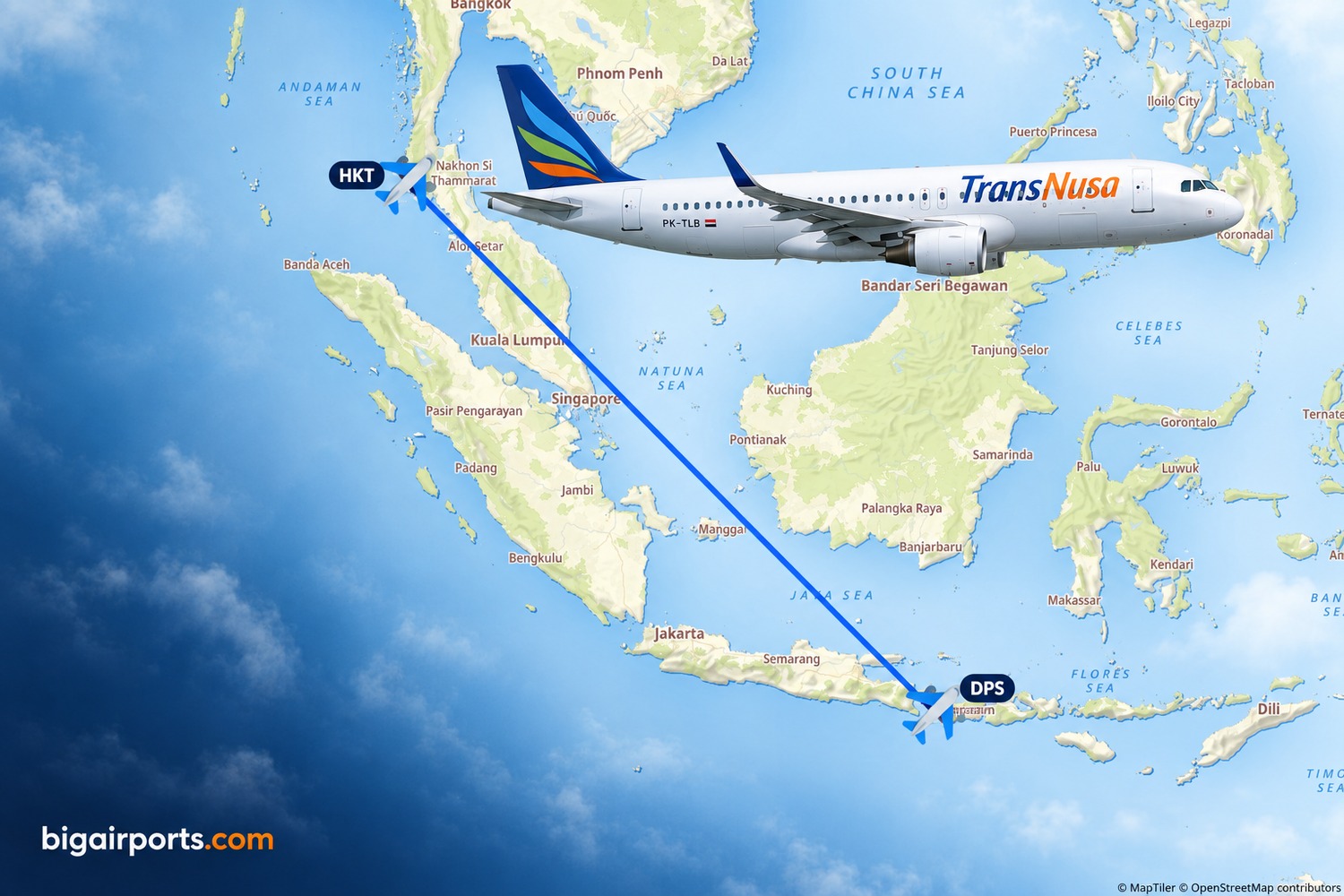
TransNusa has launched nonstop flights between Denpasar I Gusti Ngurah Rai International Airport and Phuket International Airport, with the first flight operating on 9 September 2026. The Indonesian carrier is serving the sector four times weekly with an Airbus A320 and will move to a daily operation from 3 October 2026, less than a month after launch.
- Airline
- TransNusa (8B/TNU)
- Route
- Denpasar (DPS) – Phuket (HKT)
- Aircraft
- Airbus A320
- Frequency
- 4x weekly, daily from 3 Oct 2026
- First flight
- 9 Sep 2026
Route overview
The new service operates on Mondays, Wednesdays, Fridays and Sundays during its initial phase, before the step-up to seven weekly rotations in early October. The sector covers approximately 2,650 kilometres (about 1,430 nautical miles), a routine mission for the A320 and squarely in the short- to medium-haul band where the type earns its keep. Both airports sit at the heart of their islands’ tourism economies, and the schedule is built around the leisure traveller rather than the business connector.
The pairing connects two of Southeast Asia’s largest resort islands, and it does so nonstop for the first time in the current schedule period. Passengers travelling between Bali and Phuket have until now relied on one-stop itineraries via Singapore, Kuala Lumpur or Bangkok, adding several hours and a hub transfer to what is now a single sector. The decision to accelerate to daily frequency within four weeks of launch indicates the carrier is building capacity ahead of the year-end high season, when both islands record their strongest inbound demand.
TransNusa’s network context
TransNusa resumed operations in 2022 as a scheduled carrier following a restructuring, backed by China Aircraft Leasing Group (CALC), and has since rebuilt its network from Jakarta across Indonesian domestic trunk routes and a growing set of regional international services. The airline operates a fleet of Airbus A320s alongside COMAC ARJ21-700s, with the larger Airbus type deployed on its denser and longer sectors. The regional jet handles thinner domestic markets, leaving the A320 free for routes of exactly this profile: medium-length international sectors with sustained leisure demand.
Phuket is the airline’s first scheduled destination in Thailand, extending an international footprint that has so far concentrated on Malaysia and Singapore. Launching the route from Denpasar rather than Jakarta is notable in itself: it positions Bali as an international origin point in TransNusa’s network rather than solely a domestic spoke, and places the carrier in a point-to-point leisure market where it faces no direct competitor rather than in a hub-to-hub battle against established full-service and low-cost operators.
About the aircraft
The Airbus A320 assigned to the route is the workhorse of short- and medium-haul flying across Asia, typically configured for 150 to 186 passengers depending on layout. TransNusa markets itself as a premium-service carrier at accessible fares, and coverage of the inaugural flight highlighted the full onboard service offered on the sector.
With a range comfortably in excess of 5,000 kilometres, the A320 operates the 2,650-kilometre sector without payload restriction. The type also gives TransNusa fleet commonality benefits: crews, maintenance and ground handling for the Phuket operation slot into existing A320 infrastructure at Denpasar, keeping the incremental cost of the new station largely on the Thai side.
The airports
Denpasar I Gusti Ngurah Rai International, the gateway to Bali, currently offers 74 nonstop routes according to bigairports.com network data. Its densest corridor by far is Jakarta’s Soekarno-Hatta, with 626 tracked flights across ten operators, followed by Singapore with 233 flights and nine carriers on the route. The airport’s international profile leans heavily on Australia, with Perth, Melbourne, Sydney and Brisbane all featuring among its principal markets, alongside Kuala Lumpur, Singapore and Seoul Incheon. Domestically, Surabaya, Lombok, Makassar and Labuan Bajo round out a network that mixes trunk feed with archipelago connectivity. Phuket now joins the international list as a rare intra-Southeast Asian leisure link that bypasses the region’s hubs entirely.
Phuket International, one of Thailand’s principal international gateways, currently fields 83 nonstop routes in bigairports.com data. Domestic Bangkok dominates, with 530 tracked flights to Don Mueang and a further 438 to Suvarnabhumi, while the international side is anchored by Hong Kong (234 flights), Dubai (192), Singapore (145) and Kuala Lumpur (134), plus substantial Chinese, Indian and Gulf coverage. The Denpasar service adds an Indonesian leisure market to a route map otherwise weighted towards North Asian, South Asian and Middle Eastern feed.
Market context and competition
TransNusa enters this city pair as the sole nonstop operator. The traffic that exists today moves over the very hubs both airports serve most heavily: Singapore and Kuala Lumpur appear in the top route lists of both Denpasar and Phuket, and those one-stop paths, together with Bangkok connections, have carried the island-to-island flow to date. A nonstop A320 service undercuts those routings on journey time by a wide margin, and does so without exposing TransNusa to head-to-head competition with the hub carriers on their own trunk routes.
The commercial logic rests on combining two leisure markets rather than feeding a hub. Bali and Phuket both draw large Australian, Chinese, Indian and European visitor volumes, and multi-island itineraries within Southeast Asia are a well-established travel pattern that has until now required a backtrack through a hub. Trade coverage of the launch also noted interest from inbound operators packaging the two islands together, a segment for which a four-times-weekly pattern rising to daily provides workable rotations.
The near-term test is whether year-round demand supports daily frequency once the high season ends. TransNusa’s ramp-up schedule suggests confidence, and the absence of a competitive response so far leaves the carrier a clear run at establishing the market on its own terms.
Sources & references (4)
Generated with editorial oversight from AI research.