British Airways to Fly London Heathrow to Tampa from October 2026
The carrier will operate five weekly Boeing 787-10 rotations between Heathrow and Tampa from 25 October 2026, moving the Florida route to its main hub after 41 years at Gatwick.
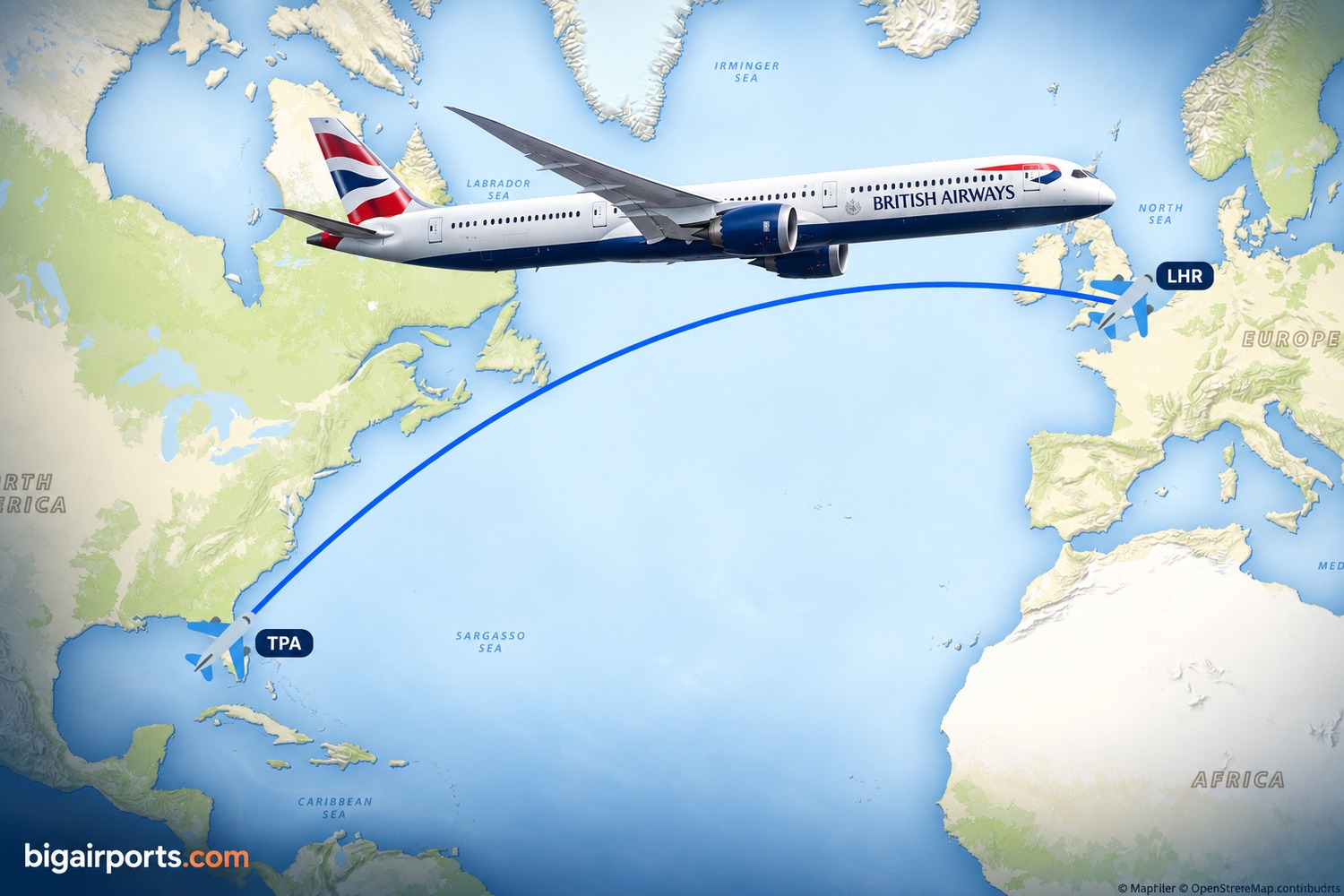
British Airways will transfer its London to Tampa service from Gatwick to London Heathrow Airport on 25 October 2026, ending a 41-year association between the Florida route and the airline’s secondary London base. Tampa International Airport becomes the newest long-haul addition at Europe’s busiest hub.
- Airline
- British Airways
- Route
- London Heathrow (LHR) to Tampa (TPA)
- Aircraft
- Boeing 787-10
- Frequency
- 5x weekly
- First flight
- 25 October 2026
Route overview
The service will operate five times weekly with the Boeing 787-10, the largest member of the Dreamliner family in the British Airways fleet. The first Heathrow departure is scheduled for 25 October 2026, the opening day of the northern winter 2026/27 scheduling season, the point in the calendar at which carriers conventionally introduce slot and schedule changes at coordinated airports.
The sector covers roughly 4,400 miles (about 7,100 kilometres) on the great-circle track, placing it squarely in the mid-range of transatlantic flying from London. With 256 seats on the aircraft, the five weekly rotations put approximately 1,280 seats per direction, per week on the city pair, capacity broadly comparable to the Gatwick operation it replaces. Westbound flights operate against the prevailing jet stream and carry correspondingly longer block times than the overnight eastbound return.
British Airways network context
British Airways announced the switch in March 2026, roughly seven months ahead of the first Heathrow flight. The carrier has served Tampa from Gatwick since 1985, making the route one of the longest-standing transatlantic services at the airport. Its relocation continues a gradual consolidation of the airline’s long-haul flying at its principal base, where the carrier concentrates the overwhelming majority of its widebody fleet and its premium-cabin demand.
Tampa joins Miami and Orlando in the carrier’s Florida portfolio, giving British Airways three gateways into the state. At Gatwick, Tampa operated with limited onward feed; at Heathrow, the flight sits within the airline’s main bank structure, connecting the Florida city to British Airways’ short-haul network across the UK and Europe as well as to its long-haul services beyond London.
About the aircraft: Boeing 787-10
The 787-10 is the largest variant of the Dreamliner, stretched to 68.3 metres and optimised for dense medium- to long-haul sectors rather than ultra-long-range flying. British Airways configures the type with 256 seats across four cabins: 8 in First, 48 Club Suite seats in business, 35 in World Traveller Plus premium economy and 165 in World Traveller economy.
The airline took delivery of its first 787-10 in June 2020, and the sub-fleet has carried the Club Suite business product from the outset, making it one of the more consistent long-haul cabins in the British Airways fleet. The type’s range comfortably exceeds the London to Tampa sector, and its four-class layout matches the mix of premium leisure and connecting traffic the carrier handles at Heathrow. Deploying the variant on Tampa also signals that the airline expects meaningful premium demand on the route, as the aircraft carries one of the highest premium-seat counts in its widebody fleet.
About the airports
London Heathrow serves 221 routes, according to network data tracked by bigairports.com, making it one of the most connected airports in the world. Its densest links are short- and medium-haul feeders: Amsterdam leads with 4,948 tracked flights, followed by Madrid at 4,425 and Barcelona at 4,320. On long-haul, New York JFK is the standout market, served by five operators with 91 tracked flights, underlining the weight of transatlantic flying in the airport’s mix. Heathrow operates on two runways at close to its permitted capacity, which is why slot availability governs most new entries and transfers.
Tampa International serves 120 routes in the same dataset, with a network that is overwhelmingly domestic. Atlanta is the busiest market, served by six operators with 162 tracked flights, while Chicago O’Hare draws seven operators, the widest field of competitors on any Tampa route. Miami, Charlotte and the New York airports of Newark and LaGuardia round out the leading links. The airport’s catchment covers west-central Florida, including St Petersburg and Clearwater, a region with substantial inbound leisure demand from the UK.
Market context and competition
British Airways was the sole nonstop operator between London and Tampa throughout the Gatwick era, and it retains that position after the move to Heathrow. No other carrier has announced service on the city pair, so the competitive pressure on the route comes from one-stop itineraries rather than head-to-head nonstop flying.
Those indirect options flow over the large US hubs already connected to Tampa. Atlanta, with six operators on the Tampa route, Charlotte, Chicago and the New York area all offer one-stop paths between London and the Florida city on US carriers and their joint-venture partners. The structure of Tampa’s own network illustrates the opportunity: all 15 of its busiest tracked routes are domestic, leaving the airport with few nonstop intercontinental links relative to its size. For passengers originating in Tampa, the Heathrow service is therefore one of a small number of direct connections to Europe, and the only one to London.
The move also changes the shape of the product on offer. From Gatwick, the route was positioned primarily at point-to-point leisure traffic. From Heathrow, with five weekly 787-10 rotations and a four-cabin configuration that includes First, British Airways is able to sell Tampa alongside its wider transatlantic schedule, with connections over London in both directions. The first eastbound departures from Tampa will follow the inaugural Heathrow service on 25 October 2026.
Sources & references (5)
Generated with editorial oversight from AI research.