Cathay Pacific Adds Hong Kong to Almaty A330-300 Route From Jan 2027
Cathay Pacific will fly three times weekly between HKG and ALA from 9 January 2027, its first Central Asian destination, entering a city pair currently served by a single low-frequency operator.
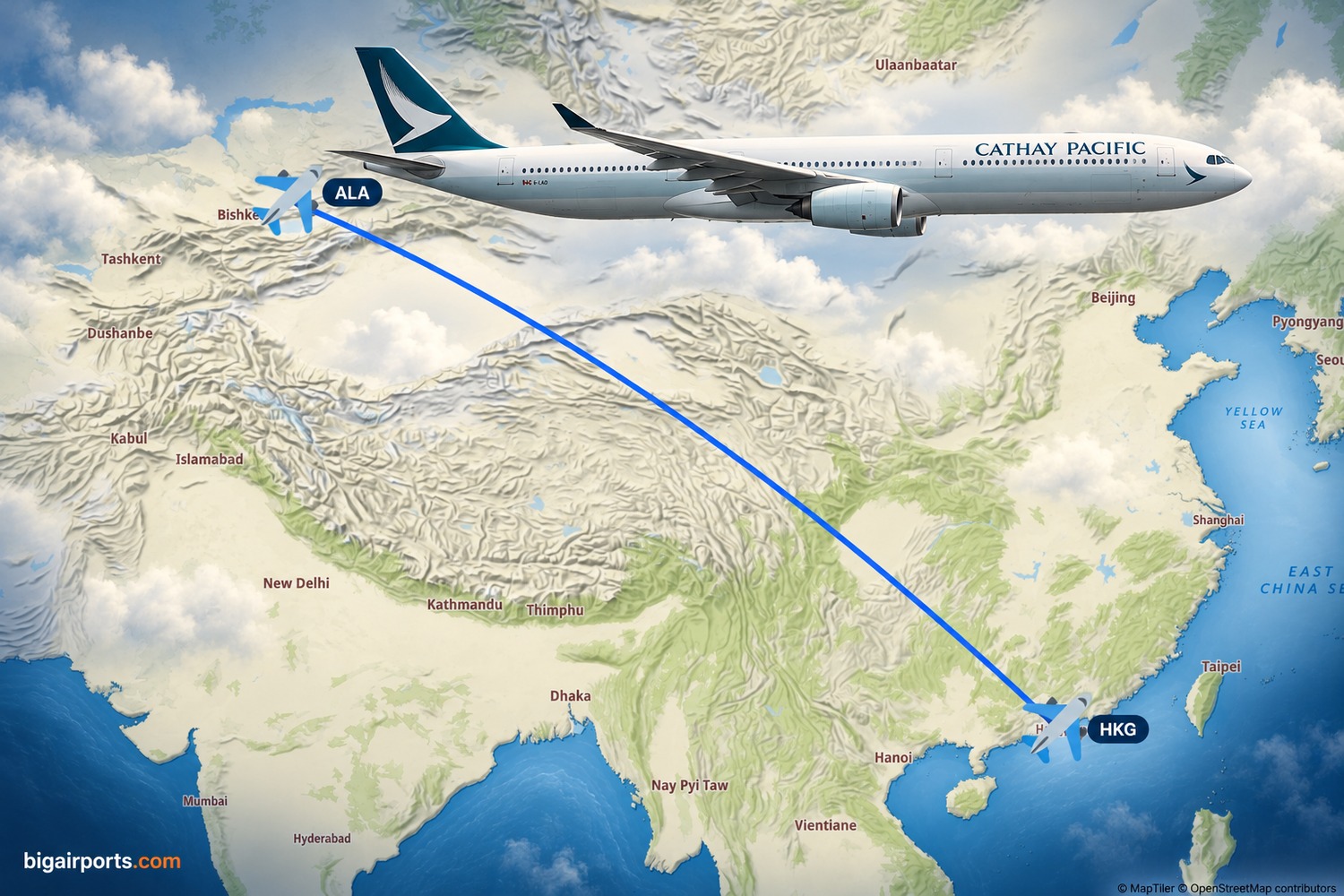
Cathay Pacific will begin three-weekly services between Hong Kong and Almaty on 9 January 2027, adding Kazakhstan’s largest city to its network for the first time. The Hong Kong-based carrier will operate the route with the Airbus A330-300, departing on Tuesdays, Thursdays and Saturdays. The schedule was announced by the airline in August 2026 and has since been loaded for sale, according to filings tracked by AeroRoutes.
- Airline
- Cathay Pacific
- Route
- Hong Kong (HKG) to Almaty (ALA)
- Aircraft
- Airbus A330-300
- Frequency
- 3x weekly (Tue, Thu, Sat)
- First flight
- 9 January 2027
Route overview
The new service links Hong Kong International Airport (HKG/VHHH) with Almaty International Airport (ALA/UAAA) over a great-circle distance of roughly 4,100 km. That places the sector at the upper end of Cathay Pacific’s A330-300 flying, closer in stage length to its Indian subcontinent services than to its intra-Asia trunk routes. Almaty becomes the carrier’s first destination in Central Asia, a region it has not previously served nonstop from its hub.
The Tuesday, Thursday and Saturday pattern gives the airline a conservative entry point. Two mid-week departures suit business and cargo demand, while the Saturday rotation captures weekend leisure traffic, all within a single aircraft rotation per operating day. Cathay Pacific has not indicated any frequency increase beyond the launch schedule, and none appears in current filings.
Airline network context
Cathay Pacific is the flag carrier of Hong Kong and a founding member of the oneworld alliance. Its passenger operation is built around a single hub at Hong Kong International, from which it connects Asia with Europe, North America, Australasia and the Middle East. The airline has spent 2025 and 2026 extending its route map after the pandemic-era contraction, with a run of new destination announcements across Asia, North America and now Central Asia, as reported by Aviation Week.
Almaty fits a pattern of secondary markets opened with the A330-300 rather than with the carrier’s larger A350 or Boeing 777 fleets. The type’s capacity, which ranges from roughly 250 to 320 seats depending on cabin layout, allows the airline to test a new market at modest risk while still offering a two-class widebody product. Kazakhstan’s government has encouraged new international air links as part of its tourism and connectivity agenda, and the Astana Times reported the Cathay Pacific announcement as a direct outcome of that effort.
For Hong Kong, the route adds a new country to the hub’s destination list and reinforces the airport’s role as a transfer point between Central Asia and the wider Asia-Pacific region, a role that has to date been dominated by mainland Chinese and Gulf hubs.
About the aircraft
The Airbus A330-300 is a twin-engine, twin-aisle widebody with a range in excess of 10,000 km in current operation, comfortably covering the Hong Kong to Almaty sector with reserves. Cathay Pacific operates a fleet of around 40 A330-300s, one of the largest concentrations of the type in Asia, and uses them across its regional and medium-haul network to destinations including Bangkok, Singapore, Delhi, Tokyo and Osaka.
On the Almaty service the aircraft will offer the airline’s regional two-class product with business and economy cabins. The A330-300 also carries meaningful belly cargo capacity, which is relevant on a route where Kazakhstan’s export base and Hong Kong’s role as a transshipment centre create freight demand in both directions. Scheduled block times are expected to be around six hours westbound and slightly less on the return, reflecting prevailing winds at cruise altitude.
About the airports
Hong Kong International Airport is among the largest hubs in Asia, with 187 nonstop routes recorded in bigairports.com data. Its densest links are regional: Taipei leads with 3,817 flights across nine operators, followed by Shanghai Pudong, Narita, Bangkok and Seoul, each with more than 2,300 flights. Seoul Incheon is served by fifteen operators, the highest carrier count on any HKG route. The airport’s long-haul profile includes Anchorage with 368 flights across eight operators, a signal of the cargo traffic that passes through Hong Kong on transpacific routings.
Almaty International Airport is Kazakhstan’s busiest gateway, with 115 routes in the bigairports.com dataset. Its single largest link is domestic: Astana with 575 flights across five operators, followed by Shymkent, Karaganda and a spread of regional Kazakh cities. Internationally, Dubai leads with 365 flights across two operators, with Istanbul at 84 flights and Guangzhou at 31. Long-haul services are thin, with Amsterdam recording 22 flights from a single operator. Hong Kong already appears in the Almaty data with one operator and 26 flights, indicating an existing but low-frequency link into which Cathay Pacific will enter.
Market context and competition
The Hong Kong to Almaty market is currently served nonstop by a single operator at roughly weekly frequency, based on the 26 flights recorded in the bigairports.com sample. Cathay Pacific’s three-weekly A330-300 service will therefore more than triple nonstop capacity on the city pair when it launches, and will do so with a widebody product rather than a narrowbody.
Beyond the nonstop market, competition comes from one-stop routings via mainland China. Guangzhou is Almaty’s principal link into southern China, with three operators but only 31 flights in the period, and connections through Urumqi, Beijing and Guangzhou have historically carried much of the Kazakhstan to Hong Kong traffic. The Gulf carriers offer a longer westbound detour via Dubai, which is better suited to Europe-bound traffic than to Hong Kong.
Cathay Pacific’s advantage lies in onward connectivity. From Hong Kong the carrier and its oneworld partners offer same-day connections to Australia, Japan, Korea, Southeast Asia and the United States west coast, markets that are poorly served from Almaty today. China Daily Hong Kong noted that the route also opens Almaty to Hong Kong’s growing outbound leisure market, where Central Asia has drawn increasing interest. Whether the carrier builds on the launch frequency will depend on how the route performs through its first northern summer in 2027.
Sources & references (6)
Generated with editorial oversight from AI research.