Jetstar Japan to Link Naha and Kaohsiung from December 2026
The Japanese low-cost carrier will fly between Okinawa and southern Taiwan three times weekly with 180-seat Airbus A320s from 6 December 2026, becoming the first Japanese LCC on the city pair.
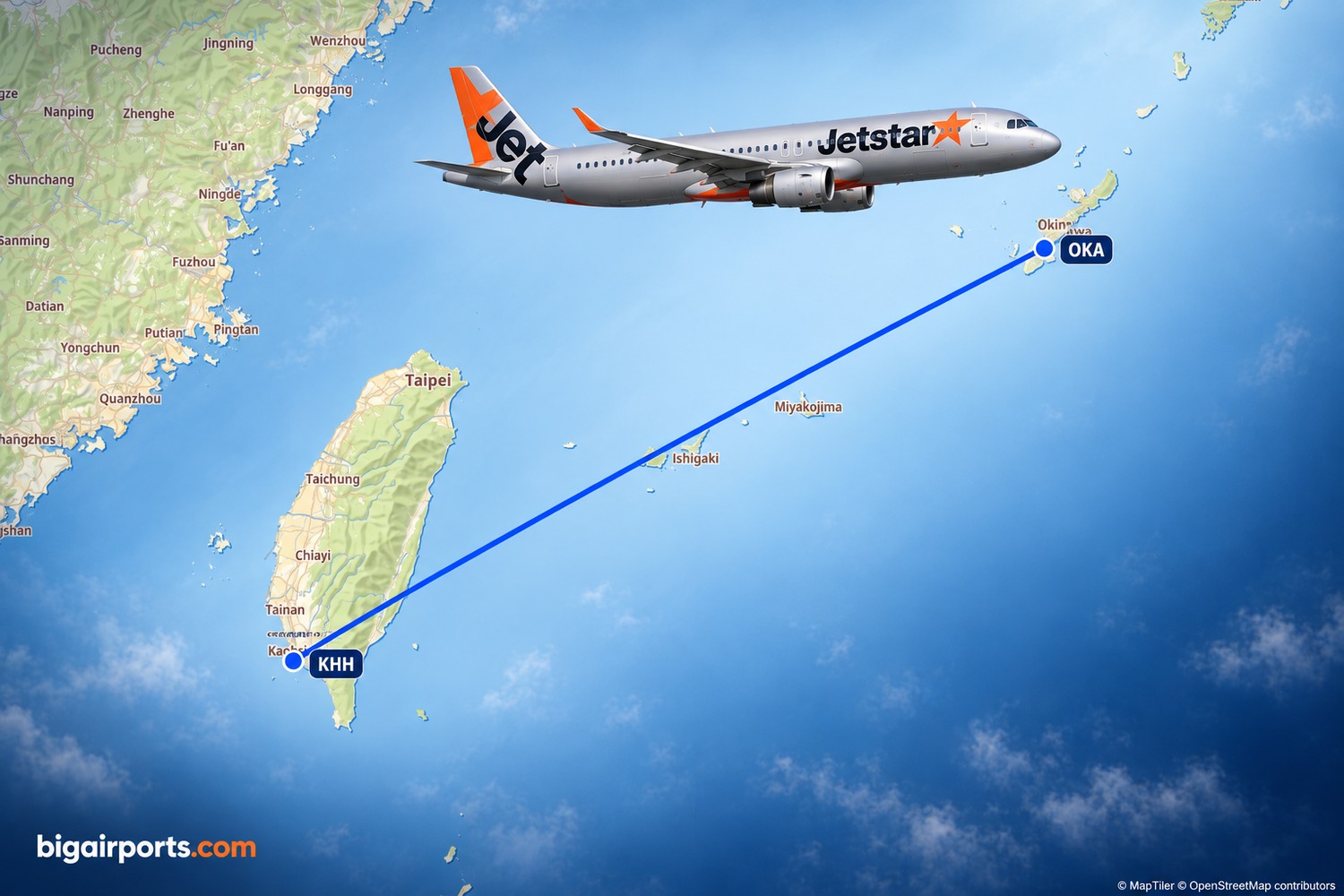
Jetstar Japan will begin flying between Naha and Kaohsiung on 6 December 2026, adding a three-times-weekly Airbus A320 service on a city pair that has so far been flown only by non-Japanese operators. Schedule filings first reported by AeroRoutes show the low-cost carrier operating on Wednesdays, Fridays and Sundays, making it the first Japanese budget airline to serve the Okinawa-Kaohsiung corridor.
- Airline
- Jetstar Japan (GK)
- Route
- Naha (OKA) to Kaohsiung (KHH)
- Aircraft
- Airbus A320
- Frequency
- 3x weekly (Wed/Fri/Sun)
- First flight
- 6 December 2026
Route overview
The sector spans roughly 840 kilometres across the East China Sea, linking Okinawa’s main island with Kaohsiung, the largest city in southern Taiwan. A stage length of this order typically translates into a scheduled block time of around two hours, placing the route firmly in short-haul territory for a narrowbody operator. The crossing is in fact considerably shorter than Naha’s densest domestic trunk to Tokyo Haneda, which runs to roughly 1,550 kilometres.
Service begins with the northern winter 2026-27 timetable, operating a fixed Wednesday, Friday and Sunday pattern. Based on the 180-seat single-class layout Jetstar Japan uses on its A320ceo fleet, the schedule adds approximately 540 seats per week in each direction, capacity aimed squarely at the leisure and visiting-friends-and-relatives traffic that dominates flows between Okinawa and Taiwan. The first departure falls on Sunday 6 December 2026, consistent with the filed operating pattern.
Jetstar Japan’s network context
Jetstar Japan is a joint venture between Japan Airlines and Australia’s Qantas Group, flying under the wider Jetstar brand. The carrier launched operations in July 2012 and is headquartered at Tokyo Narita, from which it operates a dense domestic trunk network supplemented by short-haul international services into East and Southeast Asia. The wider Jetstar brand also flies in Australia and New Zealand through Jetstar Airways, giving the Japanese unit access to group-wide distribution and a shared low-cost operating model.
Okinawa already features prominently on the airline’s domestic map, with Naha connected to the Japanese mainland by multiple daily rotations. The Kaohsiung launch therefore builds on an established station at Naha rather than opening a new outpost. According to reporting from Travelers Today, the filing makes Jetstar Japan the first Japanese low-cost carrier to commit to an Okinawa-Kaohsiung service, a corridor previously left entirely to foreign operators despite the strength of Taiwan-Okinawa traffic.
About the aircraft
Jetstar Japan operates an all-Airbus narrowbody fleet built around the A320 family. The A320ceo assigned to the route carries 180 seats in a single economy-class cabin, the standard high-density layout across the Jetstar Group’s short-haul operations. The carrier also fields 238-seat A321LRs, though those aircraft are concentrated on its densest domestic leisure routes.
For a sector of around two hours, the A320 is a conservative capacity choice: three weekly rotations of 180 seats allow the carrier to establish the route without flooding a market that currently supports a limited number of frequencies. Commonality with the rest of the fleet keeps crewing and maintenance requirements within the airline’s existing structure, and the type’s range comfortably covers the sector with full payload.
About the airports
At the Japanese end, Naha Airport is a joint civil-military airfield, sharing its runway system with the Japan Air Self-Defense Force’s Naha Air Base. A second runway, opened in 2020, eased capacity constraints at the island site. It is Okinawa Prefecture’s principal gateway, with 47 routes in the bigairports.com network dataset. The Tokyo Haneda trunk is its densest link, flown by six operators, while Taipei is its leading international market with nine operators on the pair. Hong Kong, Seoul Incheon and Shanghai Pudong also feature, and the existing Kaohsiung link is listed with three operators.
At the Taiwanese end, Kaohsiung International Airport is Taiwan’s second-largest international airport and the principal gateway to the island’s south, serving a metropolitan area of around 2.7 million people built on the country’s largest port. The airport shows 43 routes in the dataset. Hong Kong is its densest link, served by five operators, while high-frequency domestic services to Makung and Kinmen connect Taiwan’s outlying islands. Japan is already well represented: Tokyo Narita is served by six operators, Osaka Kansai by five, and Fukuoka and Naha by three each, underlining the depth of demand between southern Taiwan and the Japanese market.
Market context and competition
Jetstar Japan will not have the city pair to itself. bigairports.com network data shows three operators already active between Naha and Kaohsiung, meaning the Japanese carrier enters as a challenger on the O&D rather than a pioneer. Its distinction lies in nationality and business model: every existing frequency on the pair is flown by non-Japanese carriers, and no Japanese low-cost airline has previously served the corridor.
The underlying market is substantial. Taiwan has consistently ranked among the largest sources of foreign visitors to Okinawa, helped by flight times shorter than many Japanese domestic sectors, and Taiwanese carriers have long linked the prefecture with both Taipei and Kaohsiung. The imbalance between the two Taiwanese gateways at Naha is notable: nine operators fly the Taipei link against three on Kaohsiung, leaving the southern city comparatively underserved relative to the capital. For Okinawa, the addition broadens an international portfolio still concentrated on Taipei, Hong Kong, Seoul Incheon and Shanghai, with Kaohsiung until now the smaller of its two Taiwanese links by a wide margin.
The December launch places the route in the market ahead of the Lunar New Year period in February 2027, the traditional peak for Taiwanese outbound travel. With the addition, Kaohsiung strengthens a Japan network that already spans Tokyo Narita, Osaka Kansai, Fukuoka and Naha, while Okinawa gains its first Japanese-operated service into southern Taiwan.
Sources & references (4)
Generated with editorial oversight from AI research.