Greater Bay Airlines Launches Hong Kong-Surabaya 737-800 Service
Greater Bay Airlines began four-weekly Boeing 737-800 flights from Hong Kong to Surabaya's Juanda International on 25 September 2026, its first Indonesian route and the only nonstop service on the pair.
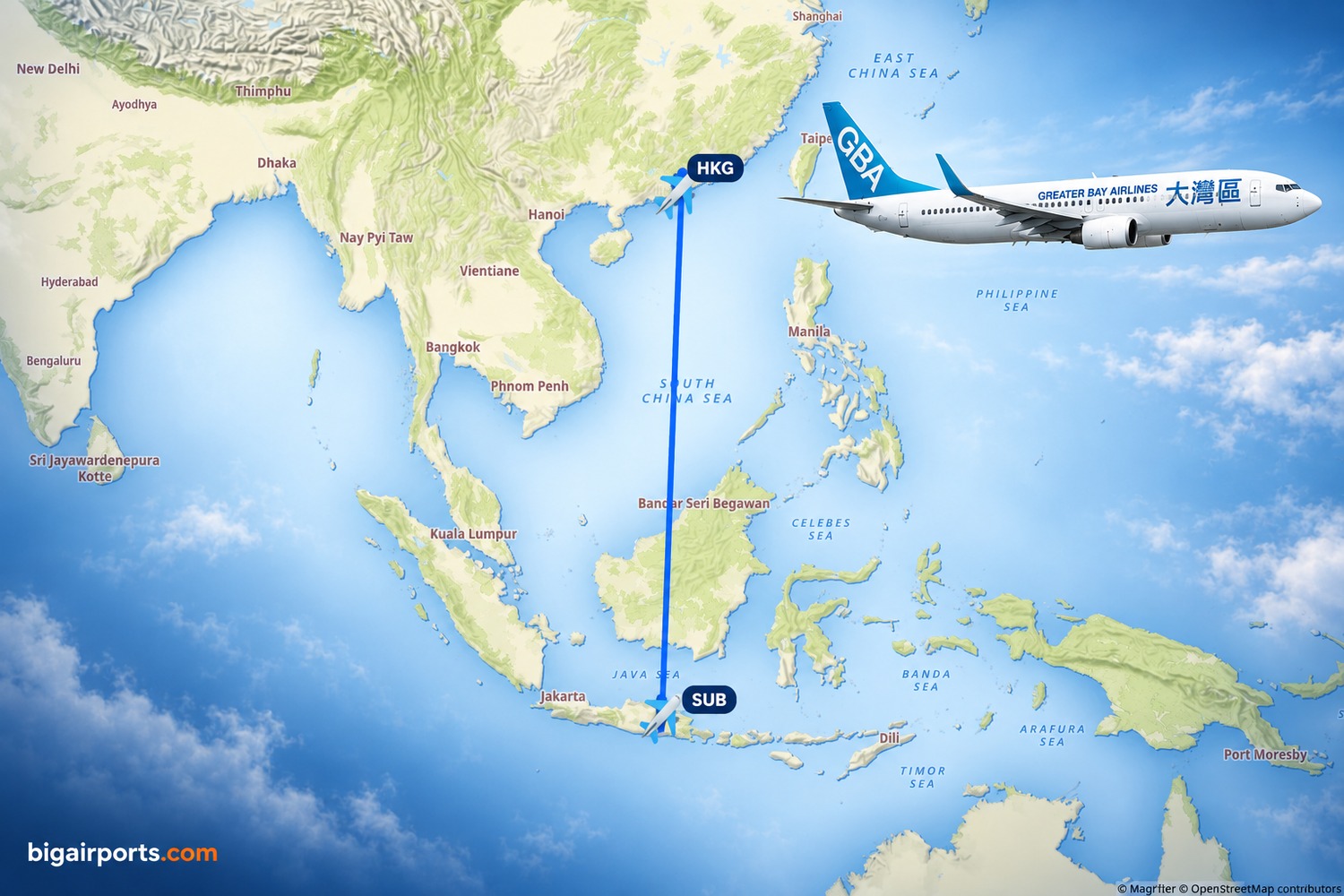
Greater Bay Airlines began scheduled service between Hong Kong International Airport and Juanda International Airport in Surabaya on 25 September 2026, its first route to Indonesia. The Hong Kong carrier operates the sector four times weekly with Boeing 737-800 equipment, adding a nonstop option on a city pair previously served only through one-stop connections.
- Airline
- Greater Bay Airlines
- Route
- Hong Kong (HKG) to Surabaya (SUB)
- Aircraft
- Boeing 737-800
- Frequency
- 4x weekly (Sun, Mon, Wed, Fri)
- First flight
- 25 September 2026
Route overview
The service operates on Sundays, Mondays, Wednesdays and Fridays, spreading the four rotations across the week. The great-circle distance between Hong Kong and Surabaya is roughly 3,300 kilometres, an almost due-south sector that produces block times of around five hours. That places the route at the upper end of the medium-haul flying that defines the carrier’s current operation, and among the longest sectors in its network.
Greater Bay Airlines configures its 737-800s with 162 seats, 12 in business class and 150 in economy, so the schedule adds 648 seats per week in each direction to the market. The four-weekly pattern leaves Tuesday, Thursday and Saturday gaps, a familiar shape for a new medium-haul market in which a carrier wants week-round coverage without committing daily capacity from the outset.
The schedule first appeared in distribution systems in April 2026, as reported by AeroRoutes, and the airline confirmed the launch through its own media channels ahead of the September start. The Standard reported the operation as the carrier’s entry into the Indonesian market, part of a wider effort to broaden its Southeast Asian coverage.
Airline network context
Greater Bay Airlines, founded by businessman Bill Wong, received its Hong Kong operating approvals in 2021 and flew its first scheduled service in July 2022. Its route map concentrates on Northeast and Southeast Asia, with services to points including Tokyo, Osaka, Seoul, Taipei, Bangkok and Manila, markets in which Hong Kong International already carries dense traffic. Growth has been deliberate rather than rapid, shaped by Hong Kong’s post-pandemic recovery and the pace at which the carrier has added aircraft, and its base gives it access to one of Asia’s strongest origin-and-destination markets.
Surabaya extends that footprint southwards and becomes the airline’s southernmost point. The carrier has standardised on a single fleet type, the 737-800, while holding orders for the Boeing 737-9 and 787-9 placed in 2023 to support longer-term development; the Indonesian launch, though, relies on equipment already in the fleet.
About the aircraft
The Boeing 737-800 is the most numerous member of the 737 Next Generation family, with an exit-limited capacity of 189 passengers in single-class layouts and a range of approximately 5,400 kilometres with winglets. Powered by CFM56-7B engines, the type saw its final commercial deliveries in 2020 as Boeing transitioned the production line to the 737 MAX, but with close to 5,000 examples delivered it remains the backbone of short- and medium-haul fleets worldwide.
Greater Bay Airlines’ two-class configuration trades density for a small premium cabin aimed at business traffic between Hong Kong and regional commercial centres. At roughly 3,300 kilometres, the Surabaya sector sits comfortably within the type’s range envelope, leaving margin for payload and alternates. The type’s economics on four-to-five-hour sectors are well established across Asian operators, and running a single fleet type keeps crewing, maintenance and spares simple for a carrier of this size.
About the airports
Hong Kong International, the carrier’s base at Chek Lap Kok, currently supports 187 nonstop routes, according to bigairports.com network data. Its densest corridors are regional: Taipei leads with more than 3,000 tracked flights across nine operators, while Shanghai Pudong, Tokyo Narita, Seoul Incheon and Bangkok each record over 1,800. The data also reflects the airport’s cargo role, with Anchorage, a technical stop for transpacific freighters, logging 368 flights across eight operators. The airport completed its three-runway system in late 2024, adding the capacity that underpins network growth by its home-based carriers.
Juanda International serves Surabaya, the capital of East Java and Indonesia’s second-largest city. Its network of 55 routes is overwhelmingly domestic: Jakarta Soekarno-Hatta leads with more than 500 tracked flights, followed by Makassar, Balikpapan and Denpasar, while secondary points such as Banjarmasin, Lombok and Palangkaraya underline the airport’s role as the gateway to eastern Java and a connecting point for Kalimantan. International service is thin, limited chiefly to Singapore and Kuala Lumpur alongside pilgrimage flights towards Saudi Arabia, and the Hong Kong service adds a scheduled East Asian link to a network otherwise oriented towards domestic trunk routes and nearby hubs.
Market context and competition
No other airline operates nonstop between Hong Kong and Surabaya, leaving Greater Bay Airlines alone on the O&D at launch. Passengers have until now connected over regional hubs: from Surabaya, Singapore and Kuala Lumpur are the natural transfer points, with 93 and 115 tracked flights respectively in bigairports.com data, while itineraries over Jakarta add a domestic leg. One-stop journey times typically run seven to nine hours depending on the connection, against about five hours nonstop. Cathay Pacific serves Indonesia from Hong Kong through Jakarta and Denpasar but does not operate to East Java.
The demand base pairs trade and manufacturing links between Hong Kong and East Java with visiting-friends-and-relatives traffic from the sizeable Indonesian community in Hong Kong. Four weekly rotations with a 162-seat narrowbody represent a measured entry: enough frequency to be usable for business itineraries, without committing capacity the market has not yet demonstrated it can absorb. The launch is also consistent with a broader pattern of Hong Kong carriers adding secondary Southeast Asian cities as the airport’s expanded runway capacity comes on line.
Sources & references (5)
Generated with editorial oversight from AI research.