Air Astana to Launch Almaty-Tokyo Narita A321LR Flights on 30 Nov
The Kazakh flag carrier will operate twice-weekly Airbus A321LR services between Almaty and Narita from 30 November 2026, creating the only nonstop scheduled link between Kazakhstan and Japan.
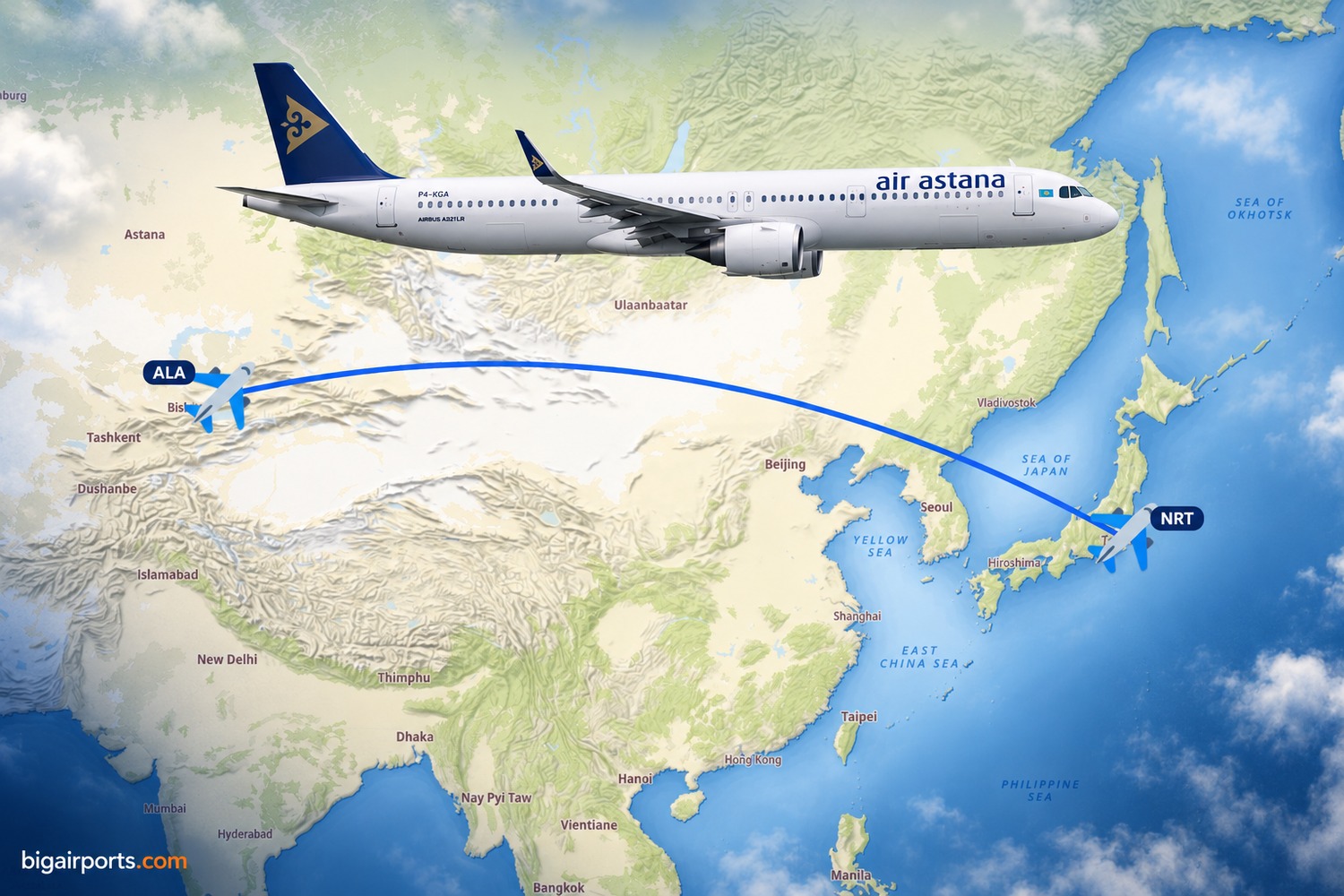
Air Astana will open a direct air link between Kazakhstan and Japan on 30 November 2026, launching a twice-weekly service between Almaty International Airport and Narita International Airport with the Airbus A321LR. Flights are scheduled to depart Almaty on Mondays and Thursdays, with return sectors leaving Narita on Tuesdays and Fridays.
- Airline
- Air Astana (KC)
- Route
- Almaty (ALA) to Tokyo Narita (NRT)
- Aircraft
- Airbus A321LR
- Frequency
- Twice weekly
- First flight
- 30 November 2026
Route overview
At approximately 5,370 kilometres (2,900 nautical miles), Almaty to Narita ranks among the longest sectors in Air Astana’s narrowbody operation. The carrier’s A321LRs are fitted with 166 seats, 16 of them in a flat-bed business cabin and 150 in economy, which puts 332 seats per week in each direction into the market at the launch frequency.
The service will be the only nonstop scheduled link between Kazakhstan and Japan. Traffic between the two countries has until now moved on one-stop itineraries, most commonly over Seoul Incheon, Istanbul, Beijing or Bangkok, with typical journey times of ten hours or more. The nonstop cuts that to a single sector of roughly seven hours.
The launch date places the route a month into the northern winter 2026-27 schedule, and Air Astana confirmed the service as part of a wider seasonal expansion announced in early October. Tokyo becomes a new country market for the carrier rather than a resumption, as Japan has not previously featured in its scheduled network. The Monday and Thursday departures from Almaty, paired with Tuesday and Friday rotations out of Narita, give the aircraft an overnight turn in Japan on each cycle and keep the pattern compatible with onward connections at the Kazakh end.
Air Astana’s network context
Air Astana is Kazakhstan’s flag carrier, operating from twin hubs at Almaty and Astana alongside its low-cost unit FlyArystan. The group listed on the London, Astana and Kazakhstan stock exchanges in February 2024 and has pursued steady international growth since, with an emphasis on medium-haul markets reachable by its narrowbody fleet.
The Tokyo launch was announced as part of a broader eastern push that also takes in new flying to Thailand and Malaysia, including Langkawi. The carrier’s existing network east of its hubs covers points in China, South Korea and Southeast Asia, and the Japanese capital extends that footprint into one of Asia’s largest and most mature aviation markets. For connecting traffic, the schedule also positions Almaty as a potential one-stop bridge between Japan and secondary cities across Kazakhstan, the Caucasus and Central Asia, markets with no realistic nonstop prospect of their own.
About the aircraft
The Airbus A321LR is the long-range variant of the A321neo, carrying additional centre fuel tanks that extend its range to around 7,400 kilometres (4,000 nautical miles). Air Astana took delivery of its first example in 2019, making it one of the earliest operators of the variant in the CIS region, and has since used the type to open and sustain long, thin international routes that would not support widebody economics.
The Almaty to Narita sector sits comfortably inside the aircraft’s operating envelope, with margin for seasonal winds and alternates. For a market being developed from a standing start, the narrowbody keeps trip costs and capacity risk low while still offering a premium cabin, a configuration suited to the mix of corporate, government and leisure traffic the route is expected to carry.
About the airports
Almaty International Airport is Kazakhstan’s busiest airport and the country’s principal commercial gateway. Network data on bigairports.com shows 110 active routes, led by the domestic trunk to Astana, which carries five operators and 575 flights in the current dataset, with Shymkent and Karaganda the next-largest domestic markets. Internationally, Dubai (298 flights across two operators) and Istanbul (84 flights) dominate the medium-haul board, while long-haul service remains thin, limited to a handful of links such as Amsterdam and Hong Kong. The airport is operated by TAV Airports, which opened a new international terminal in June 2024, substantially expanding capacity on the eve of this route’s launch.
Narita International Airport is Tokyo’s principal gateway for long-haul and low-cost traffic, with 129 active routes in the same dataset. Hong Kong is its densest market, carrying 11 operators and more than 2,000 flights, while Seoul Incheon attracts 20 operators, the most of any Narita route. The intercontinental spread runs from Los Angeles, served by nine operators, through Amsterdam, Singapore and Bangkok, to a freighter-heavy Anchorage operation. Air Astana’s arrival adds Central Asia to that mix, a region conspicuously absent from Narita’s passenger map.
Market context and competition
There is no nonstop competition on the Almaty to Tokyo city pair, and none on any Kazakhstan to Japan routing. The nearest substitutes are connecting products over Seoul Incheon, Istanbul and the main Chinese hubs, all of which add several hours and a transfer to the journey. That gives Air Astana full control of the nonstop premium on the pair, though it also leaves the carrier solely responsible for stimulating demand in a market with no established point-to-point base.
Underlying demand rests on an established economic relationship. Japanese trading houses, engineering firms and development institutions maintain a long-standing presence in Kazakhstan’s resources and infrastructure sectors, generating steady corporate traffic in both directions. On the leisure side, Japanese nationals enjoy visa-free entry to Kazakhstan for stays of up to 30 days, and Central Asia has been gaining visibility among Japanese travellers drawn to Silk Road itineraries and the mountains around Almaty. Outbound Kazakh demand to Japan spans business, education and tourism.
At two weekly rotations and 332 weekly seats each way, the entry is deliberately cautious, sized to stimulate a market rather than absorb an existing one. The route hands Almaty its first scheduled Japanese destination, gives Narita a new country on its departure board, and closes one of the more conspicuous gaps in the air map between Central and East Asia.
Sources & references (5)
Generated with editorial oversight from AI research.