Air Canada Rouge to Link Vancouver and Guangzhou from May 2027
Air Canada's leisure subsidiary will operate three weekly Boeing 787 rotations between Vancouver International and Guangzhou Baiyun from 4 May 2027, adding a rare North American nonstop at the China Southern hub.
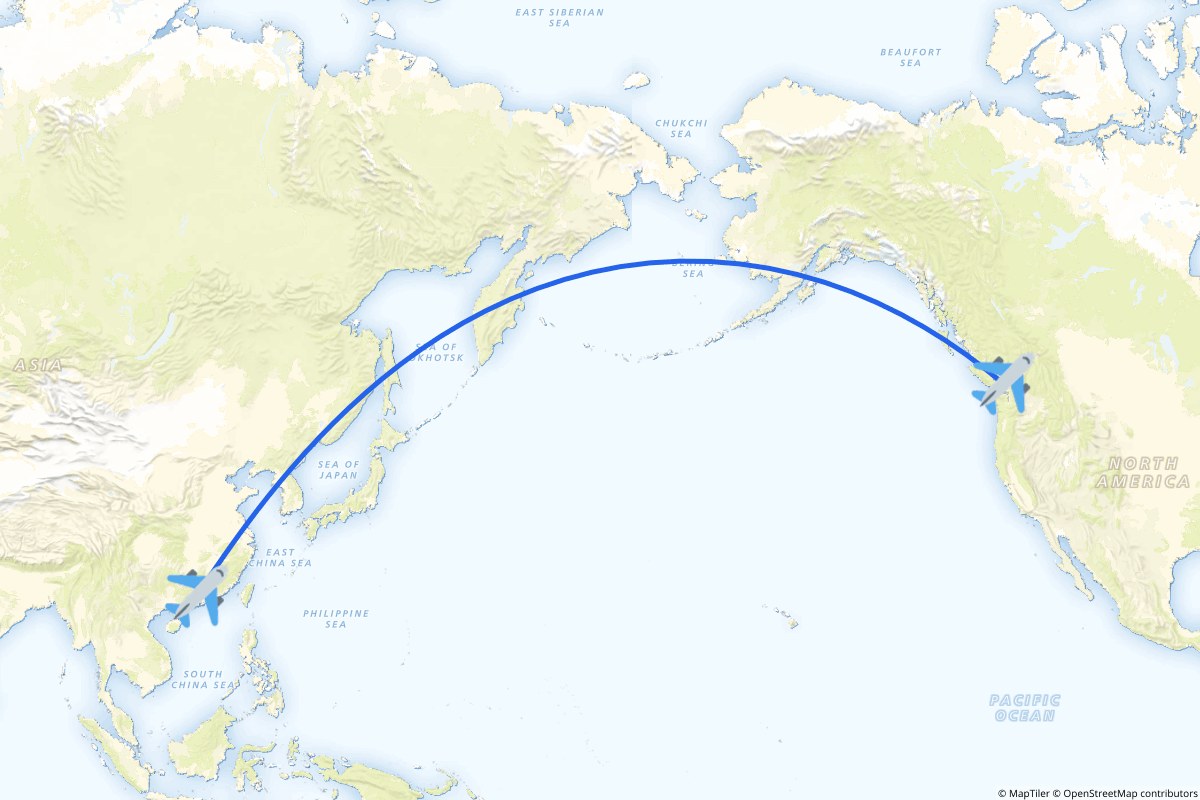
Air Canada Rouge will open a three-times-weekly service between Vancouver International Airport and Guangzhou Baiyun International Airport on 4 May 2027, deploying the Boeing 787 Dreamliner on the trans-Pacific sector. The launch gives Air Canada’s leisure subsidiary a scheduled foothold in mainland China and continues the group’s build-up of Asia-Pacific flying at its Vancouver hub.
- Airline
- Air Canada Rouge
- Route
- Vancouver (YVR) to Guangzhou (CAN)
- Aircraft
- Boeing 787 Dreamliner
- Frequency
- 3x weekly
- First flight
- 4 May 2027
Route overview
The Vancouver–Guangzhou sector covers a great-circle distance of just over 10,000 kilometres, which will place it among the longest routes flown under the Rouge brand. Air Canada Rouge will operate three rotations per week from launch; the carrier has not yet published departure timings, operating days or the seating configuration of the aircraft assigned to the service, and connection banks at either end of the route remain to be confirmed once schedules load.
The route creates a rare direct link between Guangzhou and North America. Among Baiyun’s fifteen busiest routes in bigairports.com’s current network data, Anchorage is the only North American airport listed, with three operators and 165 flights. For Vancouver, the service adds a second nonstop into the Pearl River Delta region alongside the airport’s established Hong Kong operation, giving passengers in British Columbia a direct path into southern China’s largest metropolitan cluster.
Air Canada Rouge and the wider network
Air Canada Rouge is the leisure-focused subsidiary of the Air Canada group, operating routes where demand skews towards holiday and visiting-friends-and-relatives traffic and where a lower cost base supports fares that mainline economics would struggle to sustain. The Guangzhou launch extends that model onto one of the longest sectors the unit has been handed, and marks a notable widening of its remit beyond the sun and leisure markets with which the brand has traditionally been associated.
The route also forms part of a broader trans-Pacific expansion. Air Canada has announced a slate of new routes and added frequencies across Asia, Europe and Latin America, with Vancouver positioned as its principal Pacific gateway; trade reporting around the Asia-Pacific announcements counted 14 nonstop Asia-Pacific routes from the airport. Feed for the Guangzhou service will come from Air Canada’s domestic network over Vancouver, where bigairports.com data records 533 flights to Toronto and 475 to Calgary in the current schedule, alongside dense regional links to Victoria, Kelowna and Edmonton.
About the aircraft
The Boeing 787 Dreamliner is a long-range, twin-engine widebody built around a largely composite airframe, delivering fuel burn per seat roughly 20 per cent lower than the previous-generation widebodies it was designed to replace. Those economics have made the type the standard tool for long, thin intercontinental flying — sectors with enough demand to justify nonstop service but not enough to fill a daily widebody in both directions year-round. The type’s range comfortably covers the trans-Pacific crossing in both directions, including against prevailing winter headwinds on the westbound leg.
That profile fits a three-times-weekly, 10,000-kilometre operation closely. Air Canada has not confirmed which variant will operate the route or how the cabin will be configured for Rouge service; the 787-8, 787-9 and 787-10 differ materially in seat count and range, and the choice will shape how much capacity the group commits to the market in its first season.
The airports: Vancouver and Guangzhou Baiyun
Vancouver International, located on Sea Island in Richmond, British Columbia, is Canada’s principal gateway to the Pacific. bigairports.com network data records 129 nonstop routes from the airport, with the densest domestic links to Toronto, Calgary and Edmonton, and a long-haul portfolio that includes Hong Kong, served by three operators across 351 flights in the current schedule — the airport’s largest Asian operation by volume. Seattle, San Francisco and Los Angeles anchor its transborder network.
Guangzhou Baiyun sits in the city’s Huadu district, around 28 kilometres north of central Guangzhou, and is the home hub of China Southern Airlines. The airport serves 219 nonstop routes in bigairports.com’s data, anchored by dense domestic trunk flying: 255 flights to Beijing Daxing, 247 to Shanghai Hongqiao and 215 to Hangzhou, the latter spread across twelve operators. Its international network is strongest within Asia, led by 156 flights to Kuala Lumpur, underlining how thin its direct long-haul connectivity to the Americas currently is.
Market context and competition
The most direct competitive pressure will come from China Southern Airlines, which operates its principal hub at Baiyun and has served Vancouver from Guangzhou with its own trans-Pacific flying. Air Canada Rouge will also face one-stop competition over regional gateways — most obviously Hong Kong, where Vancouver’s existing three-operator, 351-flight market offers frequent connecting options into Guangzhou by air and high-speed rail.
The demand case rests on two pillars. British Columbia is home to one of North America’s largest Chinese-Canadian communities, generating substantial two-way visiting-friends-and-relatives traffic, while Guangzhou anchors the Greater Bay Area, one of the world’s most populous and economically significant urban regions. A three-times-weekly Rouge operation represents a measured initial commitment to that market: enough capacity to establish the nonstop product, with room to add frequency or upgauge if performance warrants. Belly cargo between the Pearl River Delta’s manufacturing base and western Canada offers a secondary revenue stream on the widebody equipment.
For Vancouver, the launch reinforces its position as the primary trans-Pacific hub in the Air Canada system. For Guangzhou, it adds a scarce direct North American passenger link to a network of 219 routes that is otherwise overwhelmingly oriented towards domestic and intra-Asian flying. The first rotation is scheduled for 4 May 2027.
Sources & references (4)
Generated with editorial oversight from AI research.