Singapore Airlines Adds Singapore–Madrid Nonstop from October 2026
The Star Alliance carrier will fly five weekly Airbus A350-900 rotations between Changi and Madrid–Barajas from 26 October 2026, restoring Spain to its network and giving the city pair its only nonstop link.
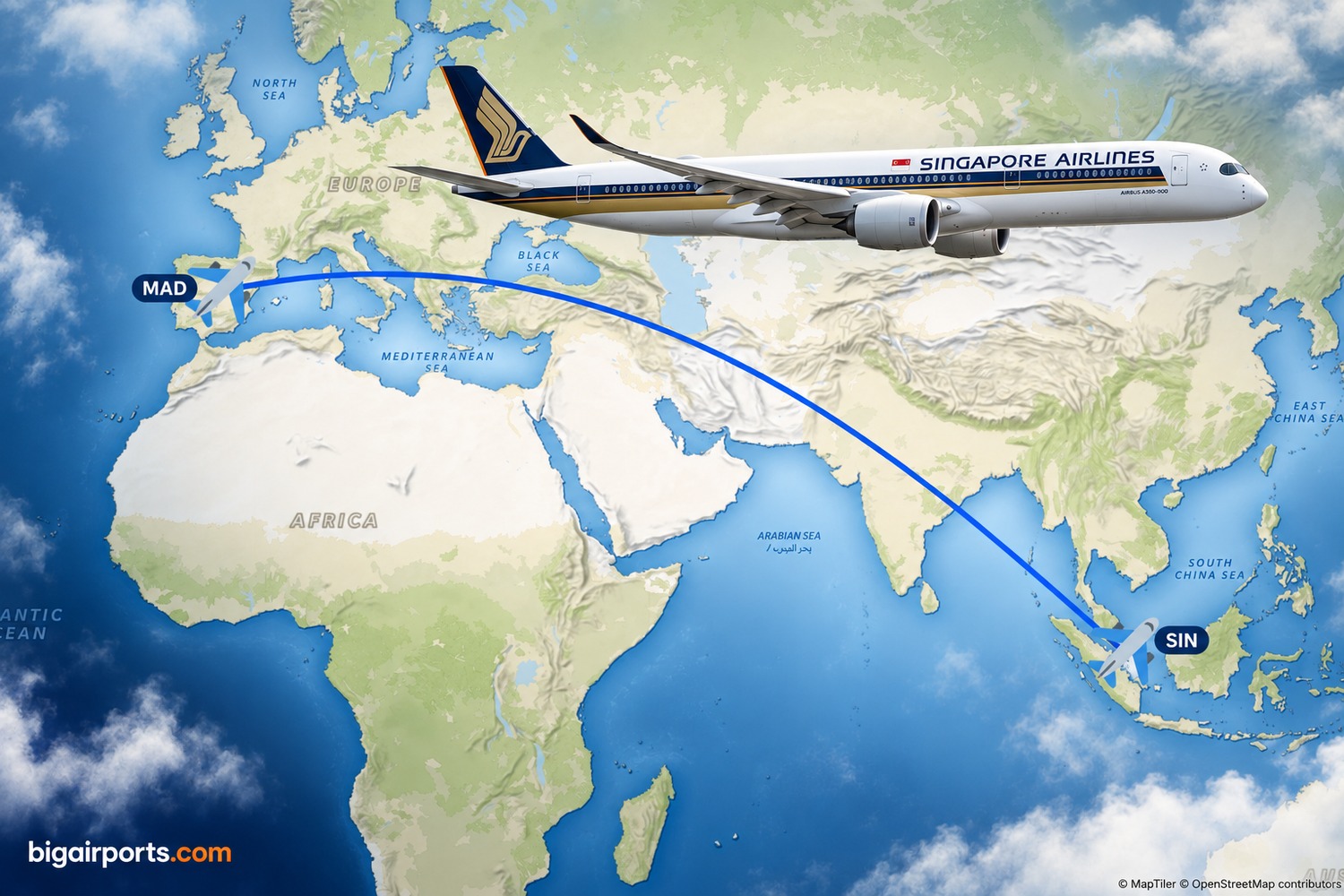
Singapore Airlines will launch nonstop flights between Singapore Changi Airport and Adolfo Suárez Madrid–Barajas Airport on 26 October 2026, operating five weekly rotations with the Airbus A350-900. The city pair currently has no scheduled nonstop service, and the launch returns Spain to the carrier’s network for the first time since its Barcelona operation ended in 2020.
- Airline
- Singapore Airlines (SQ)
- Route
- Singapore (SIN) to Madrid (MAD)
- Aircraft
- Airbus A350-900
- Frequency
- 5x weekly
- First flight
- 26 October 2026
Route overview
The start date of 26 October 2026 falls on the first day of the northern winter scheduling season, the traditional window for long-haul launches. At roughly 11,400 kilometres on the great circle, the sector will rank among the longest nonstop services operating from Madrid, with block times in the region of 13 to 14.5 hours depending on direction and prevailing winds.
The route joins two substantial networks. Changi serves 187 nonstop routes and Barajas 273, according to bigairports.com network data, making the pairing a link between Southeast Asia’s principal transfer hub and the largest airport on the Iberian peninsula. Singapore Airlines confirmed the service in a press release covering its Europe expansion for the October period, and tickets are on sale through the carrier’s usual distribution channels.
Singapore Airlines’ network context
Madrid becomes the latest addition to a European network that already includes London, Paris, Frankfurt, Zurich, Amsterdam, Milan and Rome. The launch forms part of a broader long-haul push at the carrier, which trade reports place alongside three further long-haul additions within a three-month window.
The Spanish capital is also the airline’s first destination in Spain since 2020, when Barcelona services were withdrawn during the pandemic and never reinstated. The return comes via Madrid rather than Catalonia, giving the carrier access to the larger of Spain’s two intercontinental gateways.
Alliance dynamics are worth noting. Singapore Airlines is a Star Alliance member arriving at an airport dominated by oneworld carrier Iberia, and no Star Alliance hub carrier is based at Barajas. The service will therefore depend on point-of-sale demand at both ends and on the carrier’s own connecting bank at Changi rather than on local alliance feed.
About the Airbus A350-900
Singapore Airlines is the largest operator of the A350-900 worldwide, and the type is the backbone of its European operation. The carrier’s standard long-haul variant is configured with 253 seats: 42 in business class, 24 in premium economy and 187 in economy. Business class is laid out in a 1-2-1 arrangement with direct aisle access and fully flat beds, the product Singapore Airlines deploys across its existing European trunk routes. Premium economy is arranged eight abreast and economy nine abreast, in line with the rest of the long-haul A350 fleet.
At five weekly rotations, that configuration would place roughly 1,265 seats per direction per week on the route, or about 2,530 seats in total. Powered by Rolls-Royce Trent XWB engines, the A350-900 has a published range of around 15,000 kilometres, leaving comfortable margin on the 11,400-kilometre sector even against winter headwinds.
The airports at each end
Singapore Changi Airport serves 187 nonstop routes, per bigairports.com data. Its densest link by flight count is Hong Kong, with 1,191 tracked flights spread across seven operators, ahead of Kuala Lumpur on 400 and Jakarta on 379. Jakarta and Denpasar are each served by ten competing operators, the most contested markets out of the airport, while regional links such as Bangkok, Penang and Taipei round out a schedule weighted towards intra-Asian flying. On the long-haul side, Sydney (123 tracked flights across six operators), Melbourne (112) and Tokyo Haneda (102) rank among the leading links. Changi is the home hub of Singapore Airlines and its low-cost subsidiary Scoot, and its route map reflects its role as a transfer point between Europe, Asia and the southwest Pacific.
Madrid–Barajas brings the larger network of the two, with 273 nonstop routes tracked. Spain’s busiest airport and Iberia’s hub, it skews heavily towards domestic and short-haul flying: Palma de Mallorca leads with 20,998 tracked flights across nine operators, followed by Barcelona on 18,236 and Gran Canaria on 17,562. The dense Balearic and Canary Islands links, together with services such as Lisbon, Bilbao and Valencia, give the airport substantial short-haul feed, and European links to Lisbon, Porto, Paris and Amsterdam add further volume. Barajas is also Europe’s principal gateway to Latin America, a role built on Iberia’s transatlantic operation.
Market context and competition
No airline currently operates nonstop between Singapore and Madrid. Traffic on the city pair today moves over intermediate hubs, with Emirates via Dubai, Qatar Airways via Doha and Turkish Airlines via Istanbul among the principal one-stop options, alongside transfers at other European hubs. Iberia does not serve Singapore, so the launch does not put the new entrant into direct competition with the home carrier on this market.
The nonstop product removes a connection of typically two hours or more in each direction, a material advantage for premium and corporate traffic on a market previously reliant on connections. Beyond point-to-point demand, the network geometry works in both directions: Changi’s bank offers onward connections across Southeast Asia and to Australia, where Sydney and Melbourne sit among its larger long-haul links, while Barajas provides an extensive spread across Spain and Portugal for passengers originating in Asia.
The A350-900’s belly hold also adds scheduled freight capacity on a lane that has had no nonstop widebody service. From 26 October 2026, Singapore Airlines will be the sole nonstop operator on the pair, and no competing carrier has announced plans to serve the route.
Sources & references (5)
Generated with editorial oversight from AI research.