Wizz Air to Launch Vilnius-Berlin Route Three Times Weekly
Wizz Air will connect Vilnius International and Berlin Brandenburg from 26 October 2026, operating three weekly rotations and becoming the fourth carrier on the city pair.
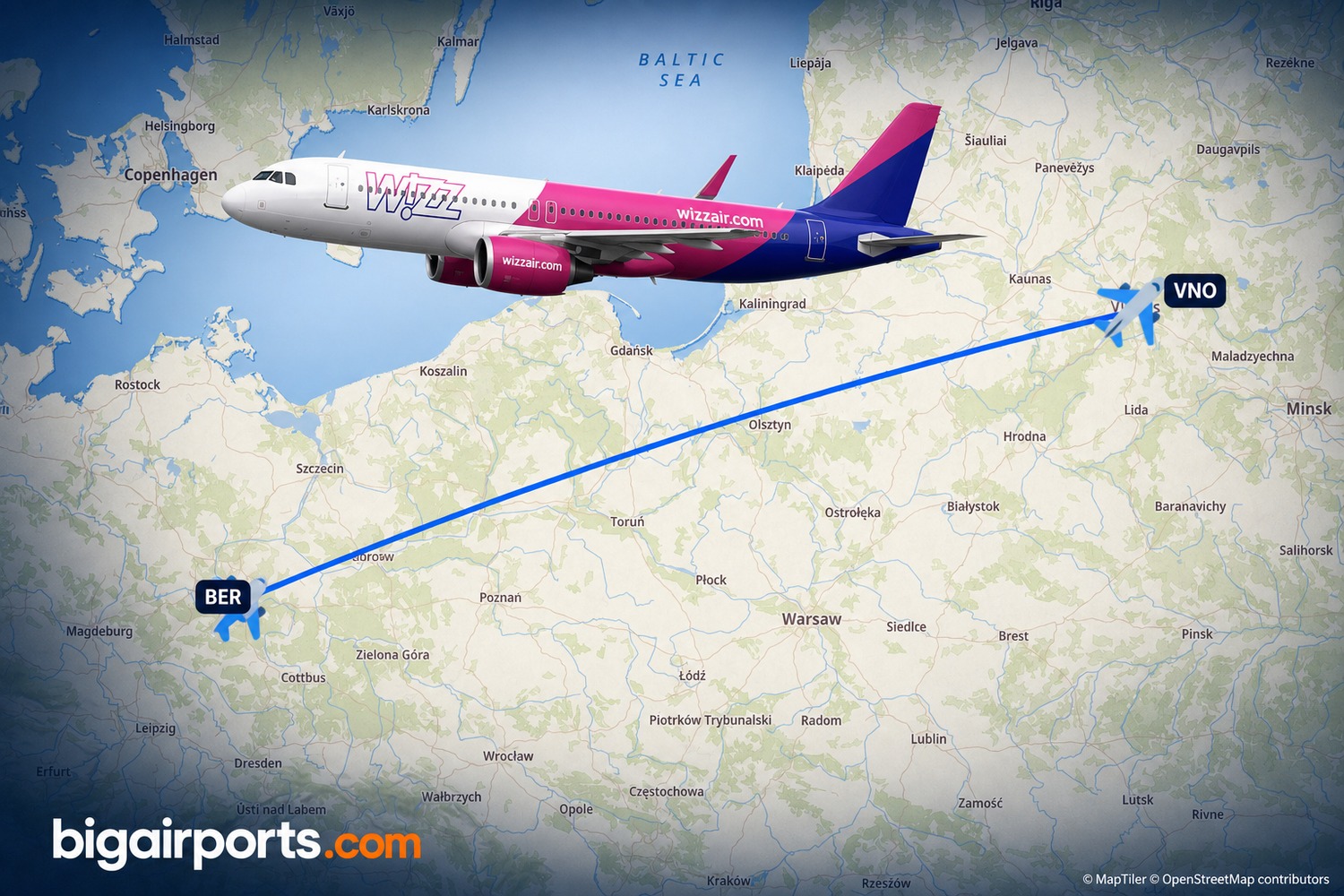
Wizz Air will launch a Vilnius–Berlin service on 26 October 2026, linking Vilnius International Airport with Berlin Brandenburg Airport three times weekly. The Hungarian low-cost carrier will operate the route on Mondays, Wednesdays and Fridays, with the start date falling on the first Monday of the northern winter 2026/27 scheduling season. Berlin Brandenburg announced the service on 13 July 2026.
- Airline
- Wizz Air
- Route
- Vilnius (VNO) to Berlin Brandenburg (BER)
- Frequency
- 3x weekly (Mon, Wed, Fri)
- First flight
- 26 October 2026
- Aircraft
- Airbus A320 family (type not confirmed)
Route overview
The new service connects the capitals of Lithuania and Germany over a great-circle distance of roughly 820 kilometres, a short-haul sector that sits comfortably within the range of any narrowbody in the carrier’s fleet. Wizz Air will operate three rotations per week, giving the city pair six additional weekly aircraft movements once the schedule is established. The Monday, Wednesday and Friday pattern spreads the three frequencies evenly across the working week rather than concentrating them around the weekend.
The launch date is tied to the calendar rather than chosen at random: 26 October 2026 is the first Monday of the winter 2026/27 season, which begins on 25 October. Timing new routes to the seasonal changeover is standard practice across the industry, allowing a service to be filed, sold and operated as part of a coherent winter programme rather than introduced mid-season.
The route was announced on 13 July 2026 through Berlin Brandenburg’s route-news channel and reported the same day by Lithuanian outlet Delfi. Departure and arrival timings for the three weekly rotations have not yet been published.
Wizz Air’s network context
Wizz Air is a long-established operator in Lithuania, having opened a Vilnius base in 2011, and the Baltic states remain a consistent part of its Central and Eastern European core. The Berlin service follows the template on which the carrier built its network: linking the capitals of Central and Eastern Europe with major Western European cities at low fares and mid-range frequencies.
The route is one of a batch of roughly 20 new European routes the airline unveiled in July 2026 for the coming winter season. It also deepens the carrier’s presence at Berlin Brandenburg, where Wizz Air already operates to a range of Central and Eastern European destinations.
For Vilnius, the service adds low-cost capacity to Germany’s capital at a time when the airport’s German connectivity is thinner than its links to the Nordics and the Benelux countries: current schedule data shows denser operations to Amsterdam, Copenhagen, Oslo and Stockholm than to Berlin.
About the aircraft
Wizz Air has not confirmed which aircraft type will fly the route. The carrier operates an all-Airbus A320-family fleet, spanning the A320ceo and A320neo alongside the larger A321ceo and A321neo. The 239-seat A321neo has become the workhorse of the operation as older ceo-generation airframes leave the fleet, while the A320neo seats 186 in the airline’s single-class configuration.
At roughly 820 kilometres, the sector is a short hop by the standards of a fleet that also supports far longer missions, and block time should come in well under two hours whichever variant is assigned. Capacity on the pair will depend on that assignment: three weekly A321neo rotations would offer just over 700 one-way seats per week, against roughly 560 with an A320neo.
Vilnius and Berlin Brandenburg: the airports
Vilnius International Airport is Lithuania’s principal gateway, currently showing 64 routes in bigairports.com network data. Its densest links are regional: Warsaw leads the table at 161 flights in the sampled schedule window, ahead of Amsterdam on 132, Riga on 123, Helsinki on 121 and Copenhagen on 111. Vienna stands out as the most contested destination from the airport, with five operators on the pair. For an airport of this size, the 64-route network is broad rather than deep: most destinations from the Lithuanian capital are served by one or two carriers at moderate frequency, and Berlin has to date sat mid-table on both measures.
Berlin Brandenburg operates at a different scale, with 169 routes in current data. The airport, which opened in October 2020 as the consolidated successor to Tegel and Schoenefeld, counts Amsterdam as its single busiest link at 937 flights in the sampled window. Leisure markets dominate the upper reaches of its route table: Palma de Mallorca records 281 flights across six operators, Barcelona 248 across three and Malaga 78 across three, while links to Frankfurt am Main, Munich and Zurich anchor the domestic and hub end of the schedule.
Market context and competition
The Vilnius–Berlin city pair is already served. bigairports.com data lists three operators on the sector, with 24 flights recorded in the current sampled window, a modest frequency total spread across a comparatively crowded field. Wizz Air’s entry takes the pair to four operators, drawing it level with Barcelona and Stockholm as the joint second-most contested route from the Lithuanian capital; only Vienna, served by five carriers, sees more competition from Vilnius.
Set against that backdrop, three weekly rotations represent an incremental rather than transformative addition of capacity, broadly in keeping with the existing pattern of operations on the pair. The more significant shift is structural: a pan-European low-cost carrier with a 15-year history in the Lithuanian market is adding Germany’s capital to its Vilnius offering, on a sector where seat supply has to date lagged well behind the airport’s Nordic and Benelux links.
The remaining unknowns are operational rather than commercial. The aircraft type, exact rotation timings and any subsequent frequency adjustments will emerge in schedule filings between now and late October, and both airports will publish the service in their winter timetables in the usual course.
Sources & references (4)
Generated with editorial oversight from AI research.