Belavia to Launch Weekly Minsk–Bangkok A330 Service on 25 October
The Belarusian flag carrier begins once-weekly Airbus A330-200 flights between Minsk National and Bangkok Suvarnabhumi on 25 October 2026, its first scheduled long-haul route since 2021.
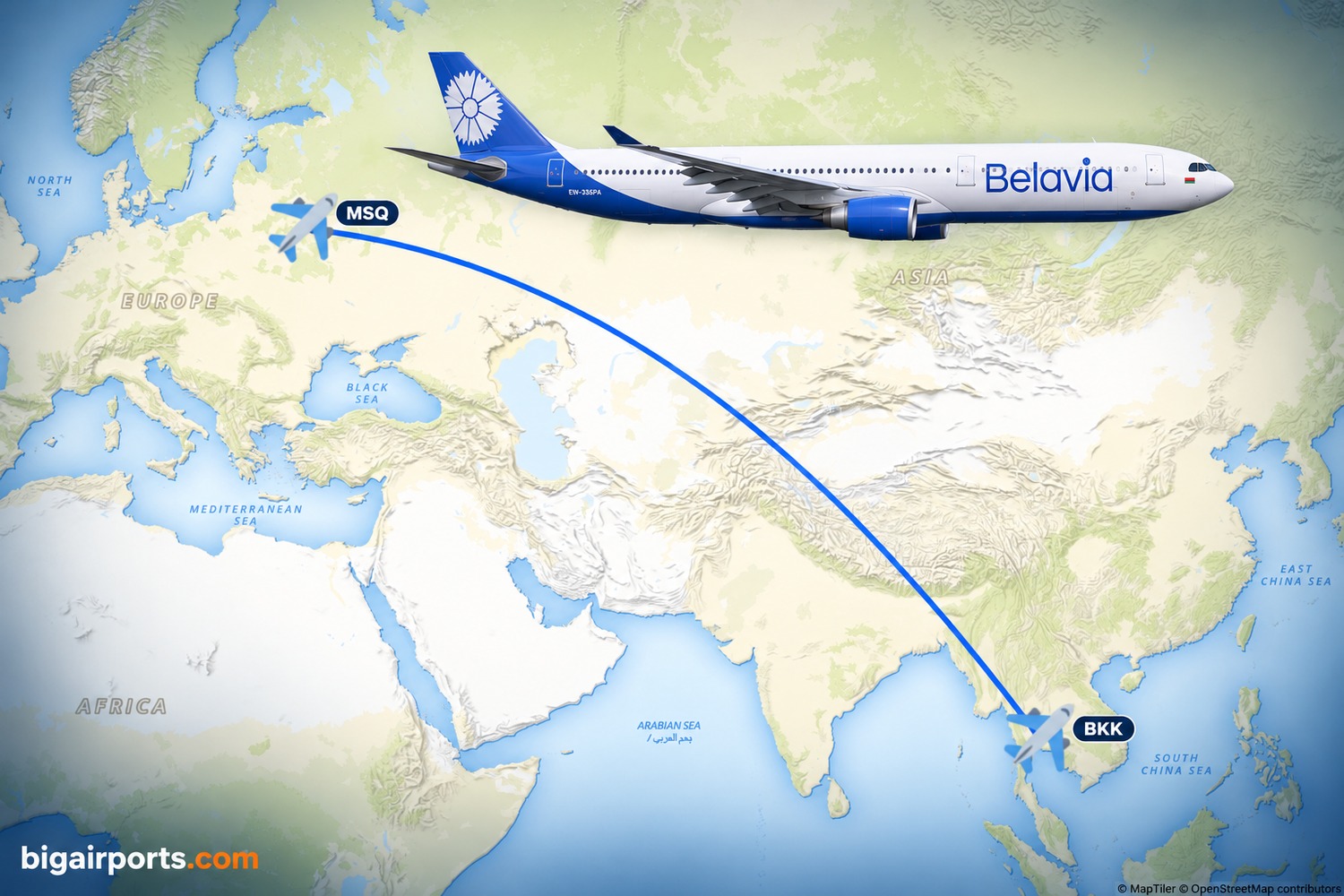
Belavia will launch a weekly scheduled service between Minsk National Airport and Bangkok Suvarnabhumi Airport on 25 October 2026, giving the Belarusian flag carrier its first scheduled link to Southeast Asia. The Minsk–Bangkok route will be operated with an Airbus A330-200 at a frequency of one rotation per week, scheduled on Saturdays, according to the carrier and Belarusian state media.
- Airline
- Belavia (B2)
- Route
- Minsk (MSQ) to Bangkok (BKK)
- Aircraft
- Airbus A330-200
- Frequency
- Weekly (Saturdays)
- First flight
- 25 October 2026
Route overview
The new sector covers a great-circle distance of roughly 7,650 kilometres, which places it firmly in long-haul territory and makes it the only long-haul route in the Minsk schedule, according to bigairports.com network data. Every other service currently operating from the Belarusian capital is a short- or medium-haul sector, with Dubai, at around 4,000 kilometres, previously the farthest point reached nonstop.
Block times on a sector of this length typically run to around nine to ten hours eastbound, with the westbound return somewhat longer against prevailing winds. With a single weekly rotation, capacity on the city pair will remain modest. The once-weekly pattern is typical for a new leisure-oriented long-haul route, allowing the carrier to test demand before committing additional widebody time. Neither the airline nor Belarusian authorities have announced plans for additional frequencies, and this article does not assume any.
Belavia’s network in context
Belavia has rebuilt its network around eastern and southern markets since 2021, when the carrier was barred from European Union airspace and most Western markets. The current map from Minsk reflects that reorientation: bigairports.com data shows 56 routes served from the airport, dominated by Russian, Turkish, Gulf, Caucasus and Central Asian points.
The densest corridors from Minsk run to Moscow, which is served across three airports: Sheremetyevo with 482 flights in the current data period, Vnukovo with 139 and Domodedovo with 132. Saint Petersburg accounts for a further 197 flights, while Dubai, with 285 flights, is the busiest non-CIS destination. Leisure traffic is concentrated on Antalya, Sharm El Sheikh and Hurghada, and regional connectivity extends to Istanbul, Baku, Tbilisi, Almaty and Tashkent.
Against that backdrop, Bangkok becomes the 57th destination served from Minsk and the first in Southeast Asia. It is also the first scheduled route from the airport to cross into the long-haul category since the network was restructured.
About the aircraft
The route will be flown with the Airbus A330-200, the shorter-fuselage member of the A330ceo family. The twin-engined widebody has a published range of around 13,400 kilometres, which leaves the 7,650-kilometre Minsk–Bangkok sector comfortably within its capability, including reserves and seasonal headwinds on the westbound leg.
In typical two-class configurations the A330-200 seats between 240 and 290 passengers, with underfloor volume for containerised cargo, a relevant factor on a route where belly freight between Eastern Europe and Thailand can supplement passenger revenue. The type remains a common choice for carriers opening thinner long-haul leisure markets, where its capacity and operating economics sit below those of larger widebodies. For a once-weekly operation, a single airframe can cover the rotation alongside other flying, keeping the fleet commitment limited while the market is proven.
About the airports
Minsk National Airport (MSQ/UMMS) is the primary gateway for Belarus and the sole base of the flag carrier’s scheduled operations. The airport currently offers 56 nonstop routes, with its busiest corridors running to Moscow Sheremetyevo, Dubai and Saint Petersburg. Two operators serve most of the principal Russian and Central Asian sectors, while the Turkish, Egyptian and Caucasus routes are largely single-carrier markets. The Bangkok launch adds a new category of operation to a network that has, until now, topped out at medium-haul range.
Suvarnabhumi Airport (BKK/VTBS) is Bangkok’s principal international hub and one of Southeast Asia’s largest gateways, with 169 nonstop routes in the current bigairports.com dataset. Its densest market is Hong Kong, served by 13 operators with 2,077 flights in the data period, followed by high-frequency corridors to Seoul Incheon, Shanghai Pudong, Taipei and Singapore. Domestic trunk routes to Phuket, Chiang Mai, Ko Samui and Krabi provide onward connectivity to Thailand’s main leisure regions, which matters for a route carrying predominantly holiday traffic from Eastern Europe. Regional links to Hanoi, Ho Chi Minh City, Phnom Penh and Yangon extend that reach across mainland Southeast Asia.
Market context and competition
There is no nonstop competition on the Minsk–Bangkok city pair: neither airport’s current route list includes the other, making this a new O&D for scheduled operations. Until now, passengers between the two cities have connected over intermediate hubs, and the Minsk network data points to the two realistic one-stop paths: Dubai, served from Minsk by two operators, and Istanbul, served by one. Both hubs offer multiple daily departures to Bangkok, so the nonstop will compete primarily on journey time and the absence of a transfer rather than on frequency.
The route follows a wider pattern of Thailand rebuilding air links with Eastern European and CIS markets, where demand is concentrated in the winter leisure season. For Suvarnabhumi, a weekly A330-200 is marginal in the context of 169 routes; for Minsk, it is a structural change to the shape of the network. The route’s performance over the 2026–27 winter season will determine whether the single weekly rotation is retained, though no party has commented on longer-term plans.
For Belavia, the operation also represents a return to widebody long-haul scheduled flying, a segment the carrier has not served since its network contracted in 2021. The airline has positioned the launch as part of a broader effort to expand into Asian markets, with Belarusian state media reporting the 25 October start date and the weekly Saturday pattern.
Sources & references (4)
Generated with editorial oversight from AI research.