Etihad Airways to Launch Abu Dhabi-Luxembourg A321neo Service
Etihad Airways will open the first nonstop link between Abu Dhabi and Luxembourg on 29 October 2026, operating three weekly Airbus A321neo rotations between Zayed International and Findel.
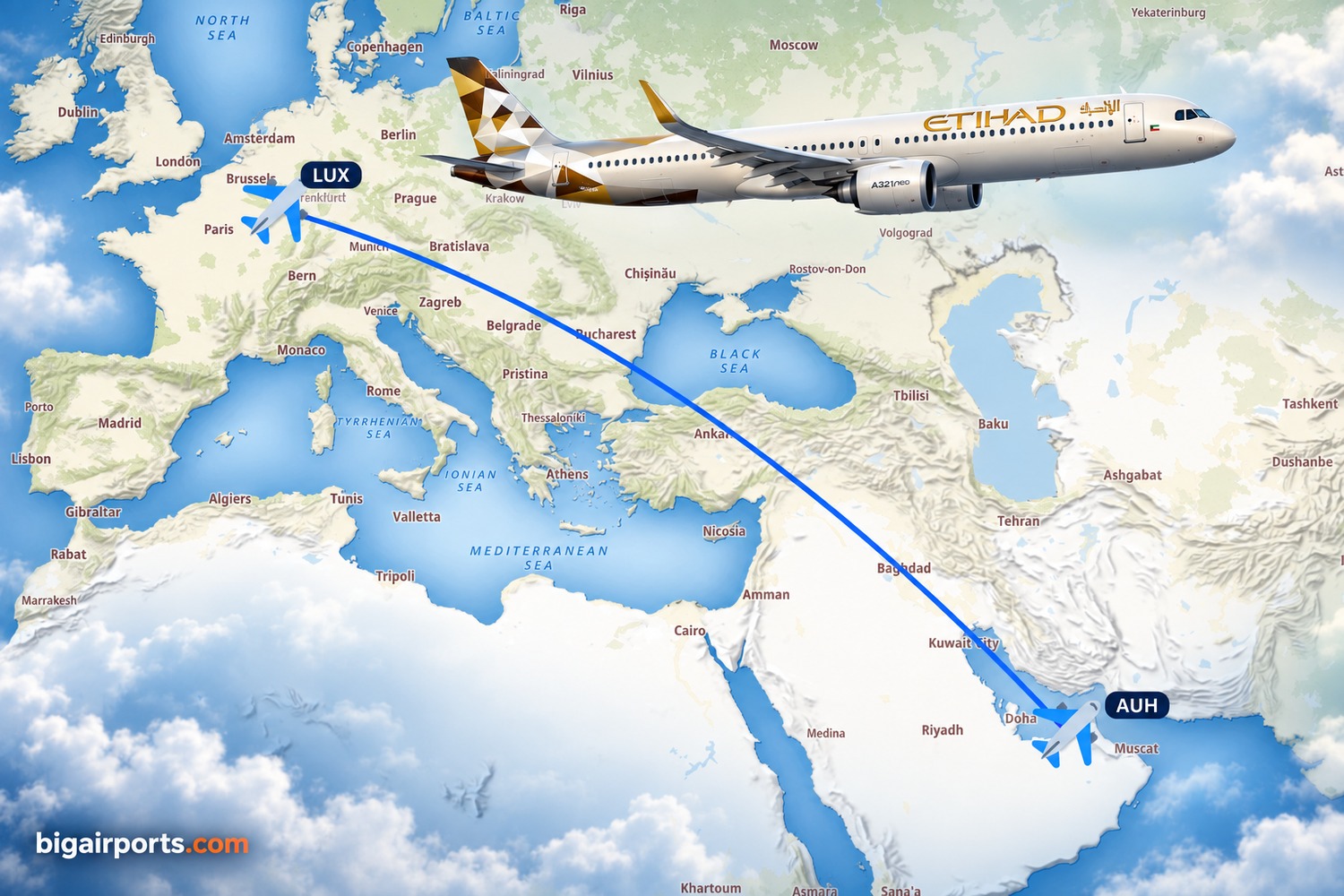
Etihad Airways will begin flying between Abu Dhabi and Luxembourg on 29 October 2026, opening the first nonstop air link between the UAE capital and the Grand Duchy. The carrier will operate three weekly rotations with the Airbus A321neo, adding Luxembourg to a European network that has grown steadily as the airline has returned to expansion mode.
- Airline
- Etihad Airways
- Route
- Abu Dhabi (AUH) to Luxembourg (LUX)
- Aircraft
- Airbus A321neo
- Frequency
- 3x weekly
- First flight
- 29 October 2026
Route overview
Flights will operate three times weekly, timed at the Abu Dhabi end to feed Etihad’s onward departures towards Asia, Australia and the Indian Ocean. According to launch reporting, this is the first scheduled nonstop service between the two cities, and the first time Luxembourg has been connected directly to the Gulf by a passenger airline. The route was announced jointly with Luxembourg officials, who have framed it as a long-sought direct link for the country’s outsized financial and institutional travel base.
The city pair is a textbook assignment for a long-range narrowbody. Demand between a market of Luxembourg’s size and the Gulf has never justified widebody capacity, which is why the connection has not existed until now. With Etihad’s latest single-aisle cabins seating 160 passengers, the schedule adds roughly 480 weekly seats in each direction, a volume the market can plausibly absorb without the risk attached to a 300-seat aircraft.
Luxembourg joins a widening Etihad network
The launch continues a sustained period of network growth at Etihad, which has been adding both trunk routes and thinner regional points from its Abu Dhabi base. bigairports.com network data shows 164 active routes from Abu Dhabi ahead of the launch, a mix dominated by dense short-haul Gulf links and medium-haul services to the Indian subcontinent, alongside long-haul trunk routes to Europe, Asia and North America.
The long-range narrowbody is central to that strategy. The type allows Etihad to open secondary European cities that sit below the viability threshold for its widebody fleet, and Luxembourg is precisely that kind of market: affluent, underserved and too small for a Boeing 787. The carrier’s existing European operation is built around major capitals and hub airports, so a direct service to one of the continent’s smaller capital-city airports marks a deliberate broadening of the map rather than more capacity on existing trunks. The narrowbody’s lower trip cost makes markets of this size testable at limited commercial risk, which is the stated logic behind Etihad’s single-aisle expansion into Europe.
About the aircraft
Etihad began taking delivery of its long-range A321neos in 2025, fitted with a three-class cabin comprising two First suites, 14 Business seats and 144 Economy seats. The configuration brings the airline’s flagship cabin products onto single-aisle routes, an unusual proposition on a sector of this length, where most European narrowbody services offer a conventional two-class layout.
The A321neo’s new-generation engines deliver roughly 20 per cent lower fuel burn per seat than the previous-generation A321, and the long-range variant can operate sectors of up to about 7,400 kilometres. That envelope places almost all of Europe within narrowbody reach of Abu Dhabi, and the Luxembourg sector sits comfortably inside it. For Etihad, the economics matter more than the range: the aircraft lets the airline test and build markets at a fraction of the trip cost of a widebody.
The airports at each end
Zayed International Airport is Abu Dhabi’s principal gateway and Etihad’s home hub, serving 164 routes according to bigairports.com data. Its densest links are regional: Doha with 258 tracked flights, Cairo with 230 and Mumbai with 205, supported by heavy frequencies to Riyadh, Bahrain, Kuwait and the Indian subcontinent. The airport’s Terminal A, which opened in late 2023, substantially raised transfer capacity and underpins Etihad’s current growth phase. Amsterdam is currently the airport’s most-served European point in the dataset, with 482 tracked flights.
Luxembourg-Findel International Airport serves 150 routes, with a network that is overwhelmingly intra-European. Amsterdam is its densest link at 964 tracked flights, followed by Palma de Mallorca with 528, Porto with 239 and Frankfurt with 232. Long-haul passenger service is scarce: Los Angeles, Hong Kong and Zhengzhou appear in the data, but at low frequencies. The airport is better known globally as a freight centre, serving as the home base of cargo carrier Cargolux, and its passenger traffic leans heavily on the financial sector, the EU institutions and the surrounding cross-border region.
Market context and competition
There is no nonstop competitor on the Abu Dhabi to Luxembourg city pair, and launch reporting indicates no other Gulf carrier currently serves Luxembourg at all. Passengers travelling between the two markets today connect over European hubs, with Frankfurt, Munich, Zurich and Amsterdam the most natural one-stop options given their frequency density from Findel.
That routing pattern is exactly what Etihad intends to intercept. Luxembourg’s catchment extends well beyond the Grand Duchy into the Greater Region, taking in parts of eastern France, western Germany and southern Belgium, a population that currently drives to Frankfurt or connects through it for Gulf and Asian destinations. A nonstop to Abu Dhabi offers that catchment a one-stop path across Etihad’s network instead.
The competitive response, if any, will come from the European hub carriers rather than from a rival nonstop; the market is unlikely to support two direct operators. For Findel, the service represents a rare addition of long-haul connectivity at an airport whose intercontinental passenger options have remained thin. The first flight is scheduled for 29 October 2026, with the route operating year-round at three rotations per week.
Sources & references (4)
Generated with editorial oversight from AI research.