Air Serbia Adds Belgrade to Miami A330-200 Service From 20 May 2027
The Serbian flag carrier will fly the roughly 8,800 km route twice weekly with its Airbus A330-200, making Miami its third US gateway after New York JFK and Chicago O'Hare and its longest sector to date.
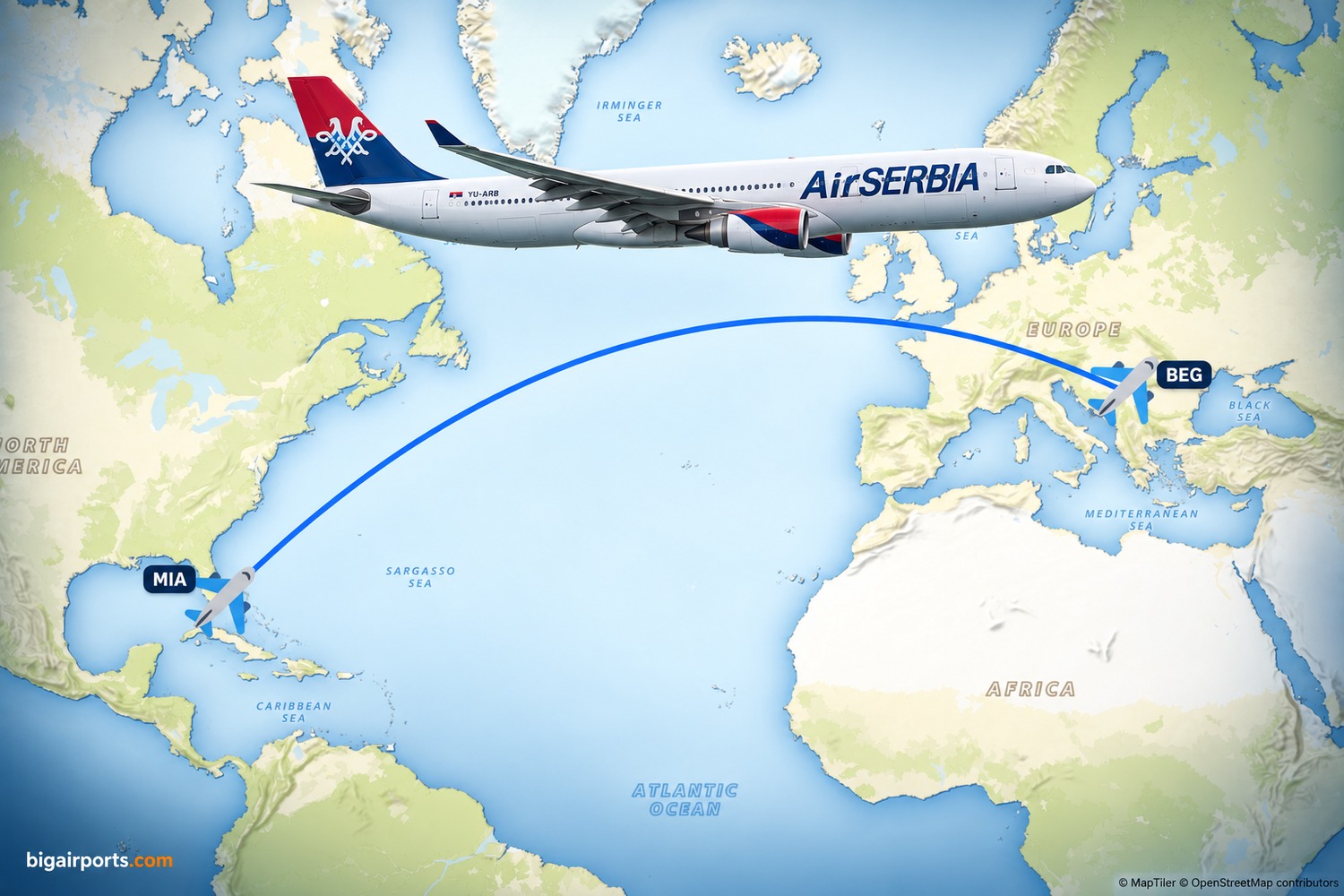
Air Serbia will launch a twice-weekly service between Belgrade and Miami on 20 May 2027, adding a third United States destination to its long-haul network. The Serbian flag carrier will operate the route with its Airbus A330-200 on Thursdays and Sundays, making Miami the longest sector in its schedule.
- Airline
- Air Serbia
- Route
- Belgrade (BEG) to Miami (MIA)
- Aircraft
- Airbus A330-200
- Frequency
- Twice weekly, Thursday and Sunday
- First flight
- 20 May 2027
Route overview
The service links Belgrade Nikola Tesla Airport with Miami International Airport over a great-circle distance of approximately 8,800 kilometres, around 750 kilometres further than the airline’s existing Belgrade to Chicago sector and some 1,500 kilometres beyond its New York service. Flights are scheduled twice weekly on Thursdays and Sundays, giving the route an initial capacity of roughly 500 seats per direction per week on the A330-200’s two-class layout. The inaugural departure from Belgrade is set for 20 May 2027, placing the launch at the start of the peak summer season.
Miami is one of six new routes Air Serbia announced in October 2026 for its summer 2027 programme, and the only long-haul addition in the batch. The service was filed roughly seven months ahead of the first departure, giving the airline a full selling window across the northern winter.
Air Serbia’s long-haul network
Air Serbia returned to transatlantic flying in June 2016 with Belgrade to New York JFK, the first nonstop service between Serbia and the United States since the JAT Yugoslav Airlines era. Chicago O’Hare followed in May 2023. Miami will be the carrier’s third US gateway and its first in the southeastern United States, where South Florida hosts a sizeable community with roots in Serbia and the wider former Yugoslavia.
The wide-body operation remains compact. Air Serbia’s A330-200 fleet also serves Tianjin and Guangzhou in China, so each North American addition has to be fitted around existing utilisation. A twice-weekly Miami frequency is consistent with the airline’s established approach of launching long-haul routes at low frequency and adding flights as demand matures.
Belgrade also acts as a connecting hub for the Western Balkans. Air Serbia is the only carrier based in the region with scheduled US flights, and it feeds its transatlantic departures from points including Podgorica, Tivat, Sarajevo, Skopje and Tirana, flown into Belgrade by its Airbus narrow-body and ATR turboprop fleet. Miami extends that connecting proposition to Florida for the first time.
About the aircraft
The Airbus A330-200 is Air Serbia’s only wide-body type. It is the shorter-fuselage member of the A330 family, trading seats for range against the A330-300. The airline configures the aircraft with 18 lie-flat business class seats and around 236 economy seats, for a total of roughly 254. The A330-200 has a published range of about 13,400 kilometres, well in excess of the Belgrade to Miami stage length even allowing for winter headwinds and fuel reserves, and its long ETOPS record makes it a conventional choice for the North Atlantic.
The type is a mature platform. Airbus has ended production of the A330ceo family, and Air Serbia’s examples are previously operated airframes sourced on the lease market. For a carrier of Air Serbia’s size, the A330-200 offers a balance of capacity and trip cost suited to thin, long sectors such as Miami, where a larger aircraft would be difficult to fill at two rotations a week.
About the airports
Belgrade Nikola Tesla Airport serves 115 routes according to bigairports.com data, almost all of them short and medium haul. Amsterdam is the most-flown link in the current dataset with 1,445 recorded flights, followed by Barcelona, Madrid and Oslo. Zurich attracts the most competition with five operators, while Amsterdam, Istanbul, Oslo and Athens each have four. Every one of the airport’s 15 busiest routes lies within Europe or Turkey, and the Moscow service, flown by a single operator, reflects Air Serbia’s position as one of the few European carriers still serving Russia. Miami will be a rare long-haul entry in a predominantly regional network.
Miami International Airport is an operation of a different scale, with 262 routes. It is the principal US gateway to Latin America and the Caribbean: Bogota alone has 22 operators, Panama City has 11, and Quito, Managua and Punta Caucedo have ten each. Across the Atlantic, Madrid is the airport’s single busiest route in the dataset with 1,558 recorded flights, while Amsterdam has seven operators. Domestic trunk routes to Atlanta, Dallas-Fort Worth, Chicago, Houston and both New York airports round out the top tier. For a Belgrade-originating passenger, Miami therefore offers onward connections well beyond Florida itself.
Market context and competition
There is no nonstop competition on the Belgrade to Miami pair. Traffic currently moves over European hubs, and the bigairports.com data shows how closely Belgrade is tied to the carriers that serve Miami: Istanbul, Frankfurt, Zurich, Paris, Amsterdam and Madrid all sit among Belgrade’s 15 busiest routes, and each of those hubs has a nonstop link to Miami. One-stop itineraries on Turkish Airlines, Lufthansa, Swiss, Air France, KLM and Iberia will remain the main alternative, and the connecting carriers can offer daily or near-daily frequency against Air Serbia’s two flights a week.
Air Serbia’s advantage lies in journey time and hub position. A nonstop sector of roughly 11 hours westbound replaces connecting itineraries that typically run to 14 hours or more, and Belgrade’s feed from Montenegro, Bosnia and Herzegovina, North Macedonia and Albania widens the catchment beyond Serbia’s own population of under seven million. Miami is also home to PortMiami, the world’s busiest cruise port, which adds a cruise-connect segment to the leisure mix.
The Thursday and Sunday pattern suits week-long and extended-weekend stays, consistent with a leisure and diaspora-led market rather than corporate demand. Frequency development after the first summer season will be the clearest signal of how the route is performing.
Sources & references (5)
Generated with editorial oversight from AI research.