IndiGo to Launch Daily Mumbai-Dar es Salaam A320neo Service
India's largest carrier will link Chhatrapati Shivaji International and Julius Nyerere International daily from 20 November 2026, deploying the 180-seat Airbus A320neo on a sector of just under 4,700 km.
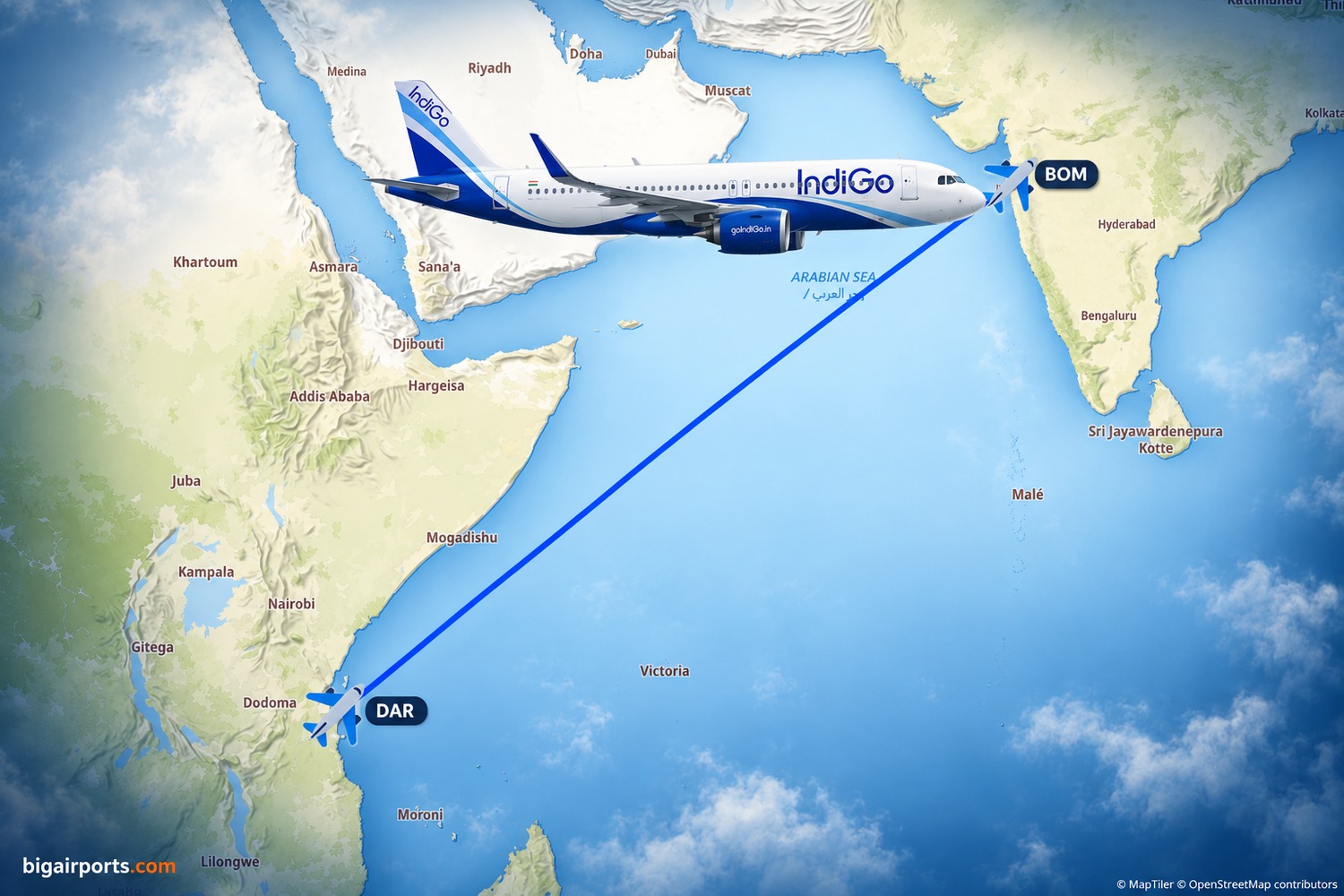
IndiGo will begin a daily service between Mumbai and Dar es Salaam on 20 November 2026, operating the sector with the Airbus A320neo. The launch, confirmed by the carrier and reflected in published winter schedule filings, connects India’s busiest western gateway with Tanzania’s largest city and adds East Africa to the airline’s fast-expanding international map.
- Airline
- IndiGo
- Route
- Mumbai (BOM) to Dar es Salaam (DAR)
- Aircraft
- Airbus A320neo
- Frequency
- Daily
- First flight
- 20 November 2026
Route overview
The new service pairs Chhatrapati Shivaji International Airport in Mumbai with Julius Nyerere International Airport in Dar es Salaam on a great-circle sector of just under 4,700 kilometres. IndiGo operates its A320neo fleet in a 180-seat single-class layout, so a daily rotation places roughly 1,260 weekly seats in each direction into the India-Tanzania market.
The route enters the schedule for the Northern Winter 2026 season, with the first departure set for 20 November 2026, and block times of around six hours put the sector towards the outer end of typical narrowbody flying. It ranks among the longer routes IndiGo assigns to single-aisle equipment, a category the carrier has steadily widened as re-engined types have extended the economics of thinner intercontinental sectors. AeroRoutes first reported the schedule filing in September 2026, and the carrier subsequently confirmed the launch.
Airline network context
IndiGo is India’s largest airline by fleet and passenger numbers, holding a domestic market share of more than 60 per cent and operating over 400 aircraft, the overwhelming majority of them Airbus A320-family jets. Its international strategy is built on nonstop narrowbody flying from Indian metros to points within roughly six to seven hours, supplemented since 2025 by wet-leased Boeing 787-9s on European trunk routes.
Mumbai is one of the carrier’s two largest bases alongside Delhi, and it has served as the launch pad for much of IndiGo’s westward growth across the Gulf and beyond. Dar es Salaam extends that reach into East Africa, a region that sits comfortably within A320neo range of India’s west coast. With an order book of close to 1,000 Airbus aircraft still to be delivered, and a stated ambition to roughly double in size by 2030, IndiGo has the equipment pipeline to keep opening routes of exactly this profile: long, thin sectors where a single daily narrowbody can set the market.
About the aircraft
The Airbus A320neo combines the established A320 airframe with new-generation engines, either the CFM International LEAP-1A or the Pratt & Whitney PW1100G, delivering around 15 per cent lower fuel burn per seat than the preceding A320ceo along with a smaller noise footprint. Airbus quotes a range of about 6,300 kilometres, leaving the Mumbai-Dar es Salaam sector well within the type’s capability with a full cabin.
IndiGo took delivery of its first A320neo in 2016 and is today the world’s largest operator of the A320neo family; the re-engined Airbus family accounts for the bulk of its fleet and underpins both its domestic network and its international expansion. On this sector the 180-seat layout matches the task: a new intercontinental market where measured capacity and low unit costs matter more than premium cabins. IndiGo operates both engine variants across its neo fleet.
About the airports
Chhatrapati Shivaji International serves Mumbai, India’s largest city and financial centre, and currently hosts 150 nonstop routes in bigairports.com network data. Delhi leads the domestic network with 580 scheduled flights across seven operators, while Dubai is the single densest sector overall at 845 flights across five carriers. Amsterdam, with 351 flights and five operators, anchors the long-haul portfolio, and heavy domestic corridors to Bangalore, Ahmedabad and Hyderabad round out the picture. The airport operates on a pair of intersecting runways and is among the most slot-constrained fields in Asia, which makes any new international narrowbody route a deliberate use of scarce capacity.
Julius Nyerere International is Tanzania’s principal gateway, with 41 nonstop routes in current data, and its international flights use Terminal 3, opened in 2019. The network skews heavily short-haul: the link to Zanzibar is by far the densest, with 279 flights across nine operators, followed by regional and domestic points such as Mount Kilimanjaro, Arusha, Mwanza and Mafia; Dodoma, the administrative capital, and coastal Tanga also feature among the domestic links. Intercontinental service remains thin, limited to Dubai, Istanbul and Amsterdam, while Nairobi, Addis Ababa and Johannesburg connect the airport to the wider long-haul world over regional hubs. IndiGo’s arrival gives the field a scheduled nonstop link to India’s largest city.
Market context and competition
Traffic between India and Tanzania today moves largely over intermediate hubs. The Dar es Salaam network data shows established services to Dubai, Nairobi, Addis Ababa and Istanbul, the connecting points through which Gulf, East African and Turkish carriers channel India-bound passengers. Dubai is the heavyweight intermediate point on this city pair: it is the densest route from Mumbai at 845 flights and one of only three intercontinental links from Dar es Salaam, at 184. A nonstop service removes the transfer entirely and shortens door-to-door journey times on an origin-and-destination market underpinned by long-standing commercial ties between western India and East Africa and a sizeable Indian-diaspora community in Tanzania.
Leisure demand adds a second layer. Dar es Salaam’s onward network, above all the nine-operator shuttle to Zanzibar, offers straightforward connections to the archipelago’s beach resorts, while Mount Kilimanjaro and Arusha feed the northern safari circuit. For IndiGo, the route follows a familiar template: one daily A320neo rotation into a market the carrier has not previously served, with schedule filings already in place for the full Northern Winter 2026 timetable.
Sources & references (3)
Generated with editorial oversight from AI research.