Shenzhen Airlines to Launch SZX-SYD A330-300 Service in December 2026
Shenzhen Airlines will begin four-weekly Airbus A330-300 flights between Shenzhen Bao'an and Sydney on 14 December 2026, giving the Star Alliance carrier its first Australian destination.
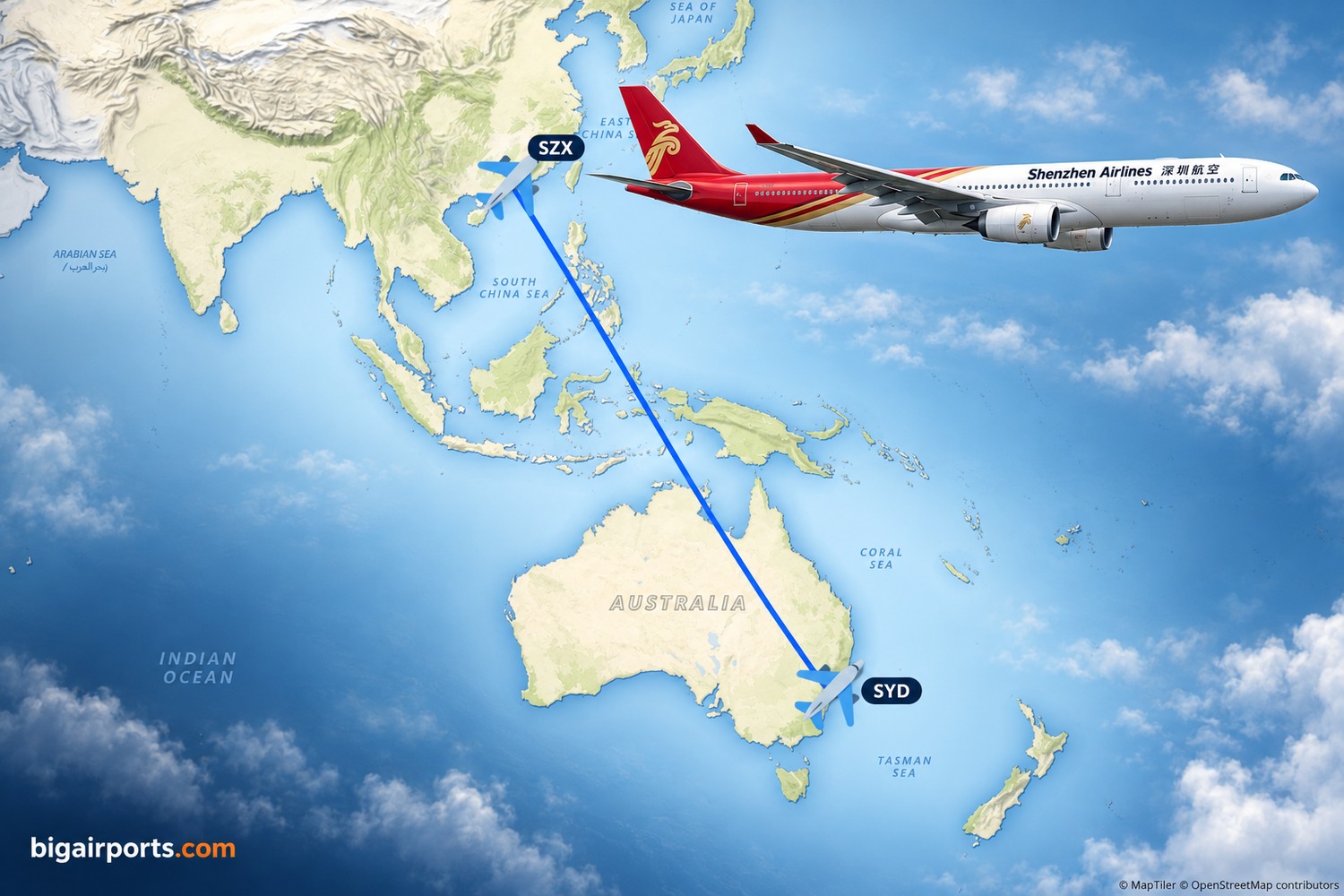
Shenzhen Airlines will open a four-times-weekly service between Shenzhen Bao’an International Airport and Sydney Kingsford Smith International Airport on 14 December 2026, deploying the Airbus A330-300 on what will become the Star Alliance carrier’s first Australian destination.
- Airline
- Shenzhen Airlines (ZH)
- Route
- Shenzhen (SZX) to Sydney (SYD)
- Aircraft
- Airbus A330-300
- Frequency
- Four weekly (Mon, Wed, Fri, Sun)
- First flight
- 14 December 2026
Route overview
The service will operate on Mondays, Wednesdays, Fridays and Sundays, spreading departures across the week rather than concentrating them around the weekend. At roughly 7,400 kilometres on the great circle, the sector will be the longest in the Shenzhen Airlines network by a clear margin, comfortably within the A330-300’s range but well beyond the regional flying that currently defines the carrier’s international operation.
Based on typical two-class A330-300 layouts of around 290 seats, the schedule equates to roughly 1,150 seats per direction per week between the two cities. That is a deliberately conservative opening position for a long-haul market entry, and one that leaves room to add frequency if the route matures.
The mid-December launch is also well timed. It puts the service in the market for the southern summer holiday period and ahead of the Lunar New Year travel peak in early 2027, the two strongest demand windows on any Australia-China city pair. The schedule was filed for sale in September 2026, giving the carrier a three-month selling window ahead of the first departure.
Airline network context
Shenzhen Airlines is majority-owned by Air China and has been a member of Star Alliance since November 2012. Its fleet is built overwhelmingly around Airbus A320-family and Boeing 737 narrowbodies, with a small number of A330s providing the carrier’s only widebody capacity. Scheduled international flying has historically concentrated on Japan, South Korea and Southeast Asia, short and medium-haul markets served largely with narrowbody equipment from the carrier’s Bao’an base. With a fleet of more than 200 aircraft, Shenzhen Airlines ranks among the largest carriers in mainland China, yet until now little of that scale has been pointed at long-haul markets.
Sydney is therefore a step change rather than an incremental addition. The route takes Shenzhen Airlines into Oceania for the first time, commits the airline to sustained long-haul widebody utilisation, and gives the Air China group a second operating presence in the Sydney market alongside the parent carrier’s own services from Beijing. For Star Alliance, it adds a further Chinese gateway feeding the alliance’s Australian network.
About the Airbus A330-300
The Airbus A330-300 selected for the route is a twin-aisle widebody with a range of around 11,750 kilometres, leaving substantial margin on the Shenzhen-Sydney sector in both directions, including against the headwinds typical of the northbound leg. Shenzhen Airlines operates the type as its sole widebody, in a small subfleet deployed to date on dense domestic trunk routes and regional international services.
Sydney will be the most demanding assignment yet for that subfleet. For a market entry, however, the A330-300 is a rational tool: it offers a lower-risk capacity point than larger twins, and keeping the new route within the existing widebody type avoids adding new crewing and maintenance complexity to what remains a narrowbody-dominated operation.
The airports: Shenzhen Bao’an and Sydney
Shenzhen Bao’an currently offers 201 nonstop routes, according to AirportRoutes network data. The schedule is anchored by China’s domestic trunk corridors: Hangzhou is the single busiest link, with more than 350 tracked flights spread across 12 operators, followed by dense multi-carrier services to both Shanghai airports and to Beijing Capital and Daxing. Chengdu, Chongqing, Xi’an, Wuhan and Kunming complete a classic mainland trunk map.
Long-haul passenger flying from Shenzhen remains comparatively thin, and the data reflects the airport’s parallel role as a major cargo gateway: Anchorage ranks among Bao’an’s busiest long-haul links, with 99 tracked flights across seven operators, traffic driven by transpacific freighters rather than passengers. A scheduled widebody passenger service to Australia is precisely the category of connectivity the airport’s route map has lacked.
Sydney, Australia’s busiest airport, offers 98 nonstop routes on current schedules. Its domestic core is formidable: Melbourne alone accounts for 660 tracked flights across six operators, one of the busiest domestic corridors in the world, with Brisbane on 417 flights and Adelaide on 205 behind it.
On the international side, Hong Kong is Sydney’s largest Greater China link, at 409 tracked flights and six operators, while Auckland leads the trans-Tasman market with seven carriers. Long-haul services to Singapore, Kuala Lumpur and Tokyo Haneda round out the Asian network into which the new Shenzhen service will slot.
Market context and competition
Shenzhen-Sydney passengers have to date largely connected over Hong Kong and Guangzhou, the two hub airports that bracket Shenzhen within the Greater Bay Area. Hong Kong’s position as Sydney’s largest Greater China link, with 409 tracked flights, illustrates how much of that one-stop capacity already exists, and Shenzhen’s cross-border rail and ferry links have long made Chek Lap Kok a de facto long-haul airport for the city.
Among mainland carriers, Air China, China Eastern and China Southern already connect Sydney with Beijing, Shanghai and Guangzhou respectively, so Shenzhen Airlines will be competing less against a direct rival on the city pair than against established one-stop routings and the pull of neighbouring hubs.
For Sydney Airport, the service adds a new mainland Chinese city to the route map at a time when China capacity has been rebuilding, and taps the corporate, student and family travel base generated by the Greater Bay Area’s technology economy. For Shenzhen Airlines, it is a test of whether the carrier can convert its home city’s economic weight into viable long-haul flying. The first departure is scheduled for 14 December 2026.
Sources & references (5)
Generated with editorial oversight from AI research.